A-Z DESIGN LEXICON: James Dyson
A-Z DESIGN LEXICON is a curated archive of the names, ideas, and works defining the design landscape.
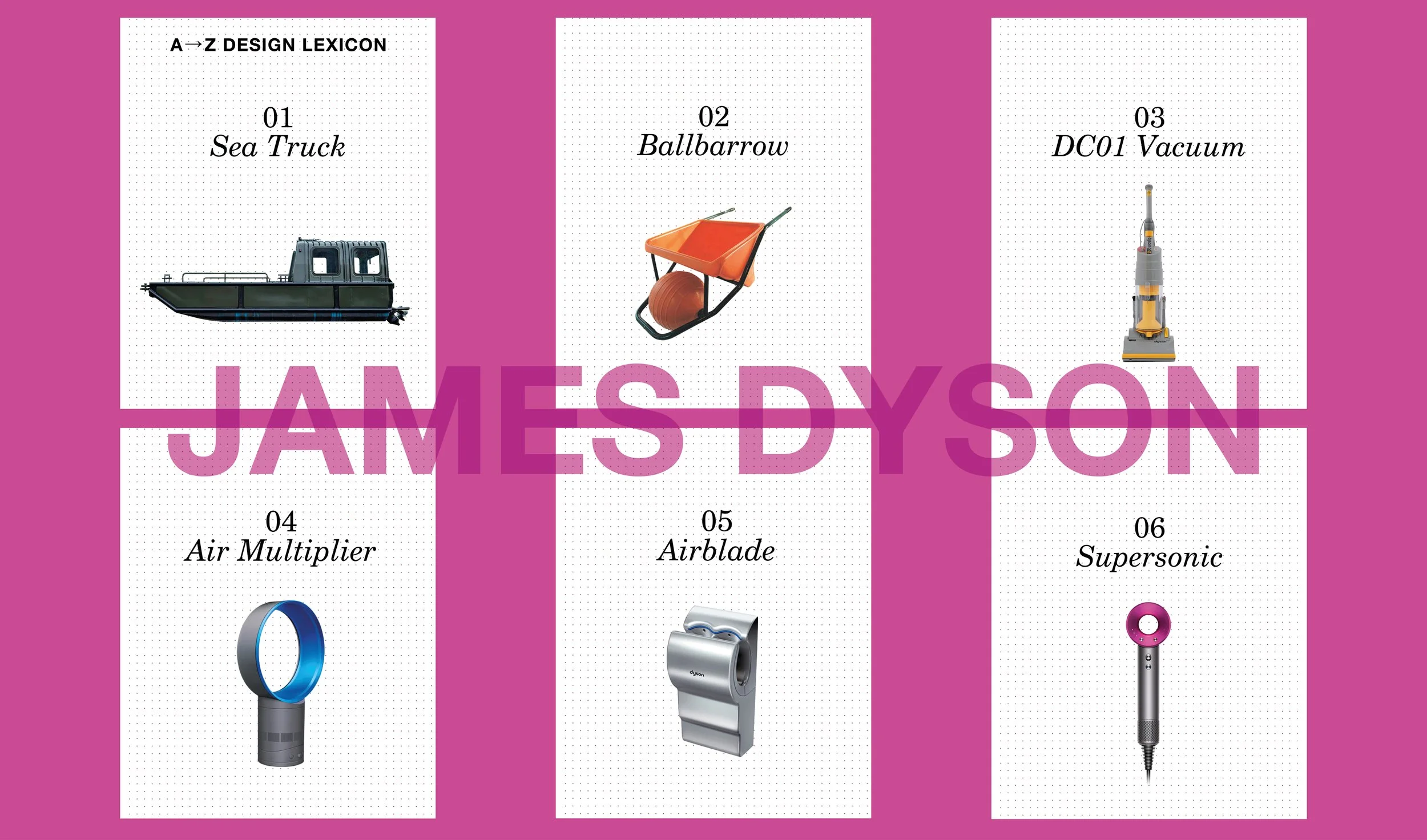
“You have to be obsessive. You have to pursue something past the point where anyone else would stop.”
James Dyson (born 1947) does not begin with form. He begins with failure — the precise, repeatable failure embedded in objects that everyone else has accepted. Where others treat compromise as inevitable, Dyson treats it as a provocation. His career is a sequence of interrogations: of the vacuum cleaner, the fan, the hand dryer, the hair dryer, the boat. Each time, the question is the same. Why does this work the way it does? And is that the only way?
Dyson’s earliest work established the pattern. The Sea Truck, designed at the Royal College of Art under Jeremy Fry, was a flat-bottomed high-speed vessel that could beach directly on shorelines and operate without dock infrastructure — a boat that made many of the assumptions of marine design redundant.
The Ballbarrow applied the same logic to a garden tool: by replacing the wheel with a sphere, Dyson solved the problem of a barrow sinking into soft ground. The ball distributed weight, resisted tipping, and navigated uneven terrain with ease. It also planted a seed he would return to: the sphere as structural solution.
The DC01 is the object on which Dyson’s reputation rests. The world’s first bagless vacuum cleaner to reach the mass market, it arrived after more than 5,000 prototypes and fifteen years of development, rejected by every major manufacturer that had a commercial interest in selling replacement bags. Its cyclone technology used centrifugal force to separate dust from airflow, producing a machine that never lost suction as it filled. The transparent bin made the internal process visible — function and honesty as a single gesture. From this foundation, Dyson extended the conversation: the Dyson Ball (2005) transplanted the sphere of the Ballbarrow into the vacuum itself, enabling it to pivot and steer around furniture; the V11 (2019) took the cyclone principle entirely cordless, closing a design argument that had begun three decades earlier.
The Air Multiplier removed the blades from a fan.
The Airblade replaced heat-based hand drying with two high-velocity sheets of air that scraped water from skin in under ten seconds.
The Supersonic relocated the hair dryer’s motor from the barrel to the handle, rebalancing the object and adding a sensor that monitored temperature twenty times per second. Each product entered a mature category and found, beneath the surface of the familiar, a problem that had simply been tolerated. Each answered it not by adding complexity, but by rethinking what the object actually needed to do.
Dyson’s work does not ask to be admired. It asks to be understood. The interior logic — the cyclone, the digital motor, the air knife — is always the point. In his hands, engineering is not the means to a designed object. It is the argument the object is making.