A-Z Design Lexicon: Charles & Ray Eames
A-Z DESIGN LEXICON is a curated archive of the names, ideas, and works defining the design landscape.
Design is an expression of the purpose. It may (if it is good enough) later be judged as art.
There is a particular kind of designer who does not begin with beauty. Ray and Charles Eames began with a question — one they returned to throughout their lives, in different materials, at different scales, with different collaborators: what is the best way a given thing can be made? Not the most expensive. Not the most original. The best. The answer, they believed, could be arrived at through rigorous experimentation and genuine curiosity, and almost as a consequence — slowly, at a mature stage — it would be irreducibly beautiful.
Charles Eames (1907–1978) and Ray Kaiser Eames (1912–1988) met at the Cranbrook Academy of Art in Michigan, where Charles was teaching and Ray was a student. They married in 1941 and moved to Los Angeles, setting up a practice that defied easy categorisation. They made furniture, films, exhibitions, architecture, toys, and television. They thought about communication as hard as they thought about construction. To the Eameses, a chair and a documentary about the solar system were not different disciplines — they were the same discipline, applied to different problems.
Their partnership was an equal one, though history took longer than it should have to acknowledge Ray’s contributions. The colour, the texture, the compositional instinct that made their work feel alive rather than merely resolved — much of that was Ray. Her training as a painter bore witness to this sensibility. Her skill showed everywhere — not in decoration, but in the calibration of every surface, every proportion.
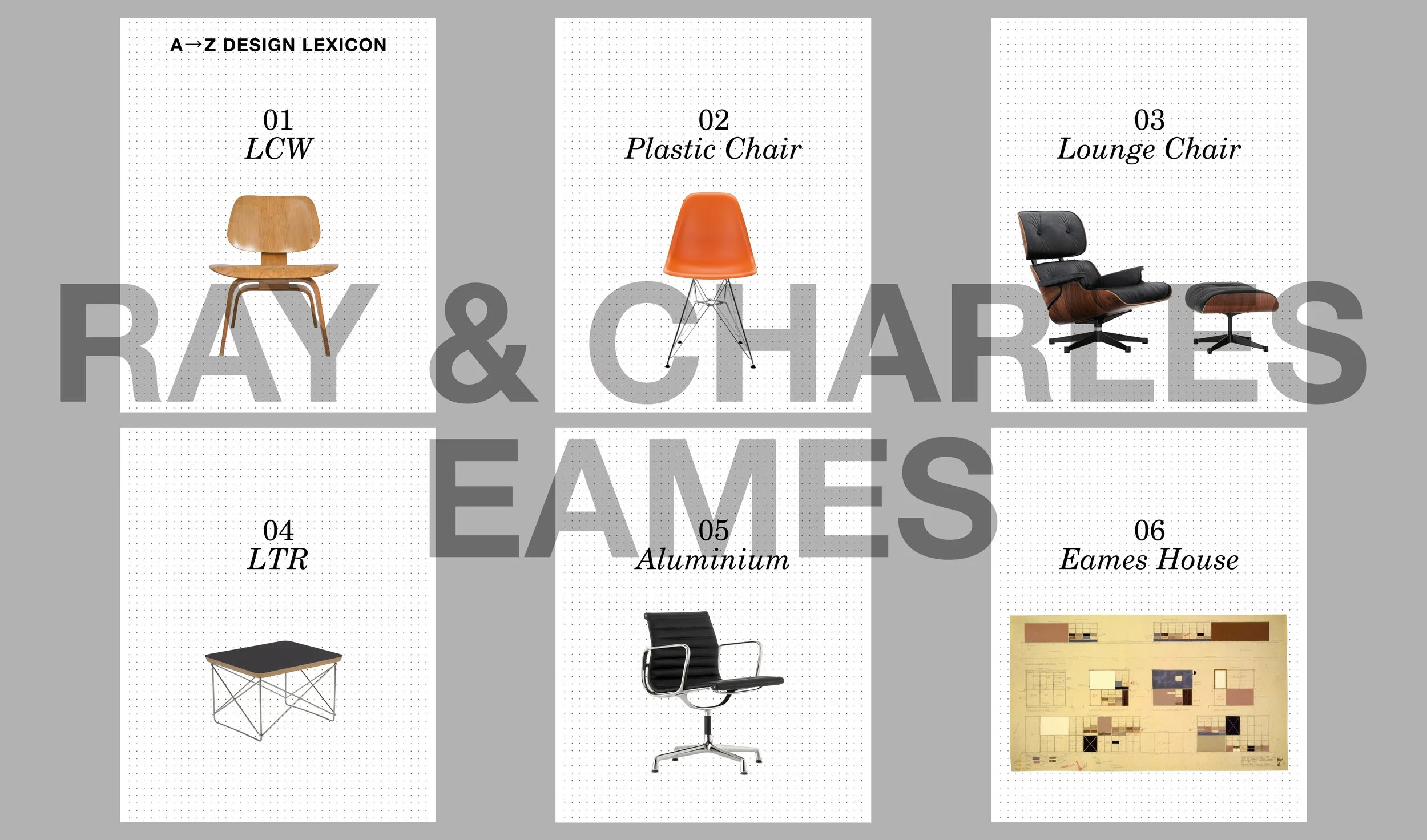
LCW — Lounge Chair Wood (1945, Herman Miller)
The LCW arrived early and announced everything. Molded plywood — a material the Eameses had been developing through wartime contracts producing leg splints for the US Navy — was shaped into two separate shells, one for the seat and one for the back, joined by a rubber spine that absorbed movement and distributed weight.
Time magazine would later name it the chair of the century. What it demonstrated was not its unexpected elegance, but the appearance of a solution: the correct form for this material, for this body, for this purpose.
Molded Plastic Shell Chair (1950, Herman Miller)
The Molded Plastic Shell Chair extended that logic into a new material and, more importantly, into a new economy. The organic, body-shaped shell — available on a variety of bases, from the wire Eiffel to the rocker — was the first mass-produced plastic chair. It made considered design available to people who could not afford considered design. This was not incidental to the project. It was the project. The Eameses believed that good design was a democratic right, not a luxury, and the Shell Chair was their most direct argument for that position.
Lounge Chair and Ottoman (1956, Herman Miller)
The Lounge Chair and Ottoman operates in a different register from their other pieces. Larger, warmer, frankly indulgent, it was designed to have, as Charles put it, the look of a well-used first baseman’s mitt — something that belonged to you before you sat in it. Sculpted rosewood shells cradle full leather cushions; the ottoman, so often an afterthought, is as carefully considered as the chair itself. It is the Eameses’ most human object: a machine for rest, built with the same rigour they brought to everything, and the same affection.
LTR — Low Table Rod Base (1950, Herman Miller)
The LTR asks for less attention than the others and repays it quietly. A small square surface on slender welded wire legs, it was a piece of furniture at the scale of a gesture. At the Eames House in Pacific Palisades, Ray used it constantly — setting out cups and objects for the tea parties she hosted, arranging things with her characteristic precision and warmth. The LTR understood what a table could be when you stopped asking it to be important: a surface at the right height, in the right place, ready to receive whatever was needed. The influence of the LTR on the conception of the later Elliptical Coffee Table is unmistakable.
Aluminum Group Chair (1958, Herman Miller)
The Aluminum Group Chair came from a commission for the terrace of a private estate, and it resolved a problem that had not quite been named yet. A taut panel of fabric or leather, suspended between two cast aluminum side rails, produced a seat that was at once light, strong, and responsive to the body in a way that upholstered chairs were not. It became the template for the modern executive chair — a fact that reveals more about the intelligence of the original proposition than about any ambition to furnish boardrooms.
Eames House — Case Study House #8 (1949, Pacific Palisades)
The Eames House was the practice made domestic. Built as part of the Arts & Architecture Case Study program, it used standard industrial components — steel H- columns, open web joists, prefabricated panels in clear and translucent colours — to create a home of extraordinary lightness and warmth. The Eameses lived in it for the rest of their lives. It was, in that sense, their longest argument: that beauty did not require bespoke means, that the industrial and the intimate were not opposites, that a house assembled from a catalogue could also be a place of genuine joy.
What binds these six works is not a style. The Eameses were suspicious of style, precisely because style can be applied from the outside, and they were interested in what came from within — from the material, the process, the use. Their consistent preoccupation was the harmony between a thing and its purpose, and the conviction that when that harmony is right, something larger than function is achieved. Not art, exactly, though the objects have ended up in museums. Something more useful than art: the sense, when you sit in a chair or rest a cup on a table, that someone understood exactly what you needed and cared enough to make it well.