Milan Design Week 2026: A Personal Edit
Fuorisalone as it should be experienced — slowly, deliberately, and with a willingness to get lost.
There is a particular pleasure in arriving in Milan the weekend before Design Week opens. The city is still gathering itself — installation crews visible through ground-floor windows, opening night invitations multiplying in your inbox, the aperitivo bars of Brera beginning to fill earlier and earlier. By Monday morning, the whole organism has woken up, and the only reasonable response is to choose well and move slowly.
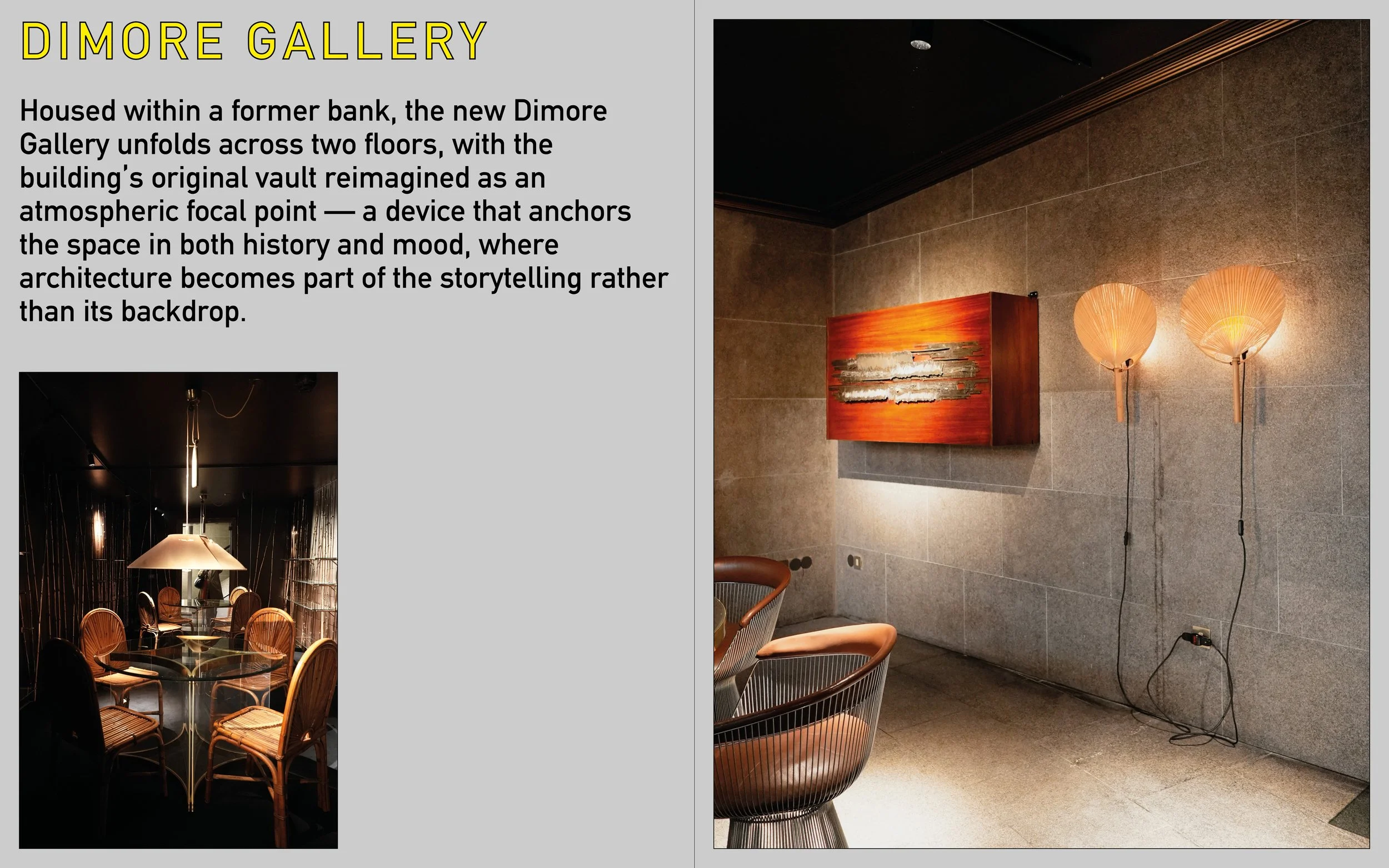
Dimoregallery — Via San Vittore al Teatro
Housed within a former bank, the new Dimoregallery unfolds across two floors, with the building’s original vault reimagined as an atmospheric focal point — a device that anchors the space in both history and mood, where architecture becomes part of the storytelling rather than its backdrop. Historic furnishings sit alongside contemporary pieces by Dimoremilano and Interni Venosta, each selected not for accumulation but for intention, while references to key figures in Italian design — including Luigi Caccia Dominioni, Nanda Vigo, and Osvaldo Borsani — reinforce the idea that design is a living continuum. Collaborations with Cardi Gallery brought works by Jannis Kounellis and other 20th-century masters into the mix, dissolving the boundaries between furniture and art — this is Dimore at their most considered, a space that rewards slower looking.
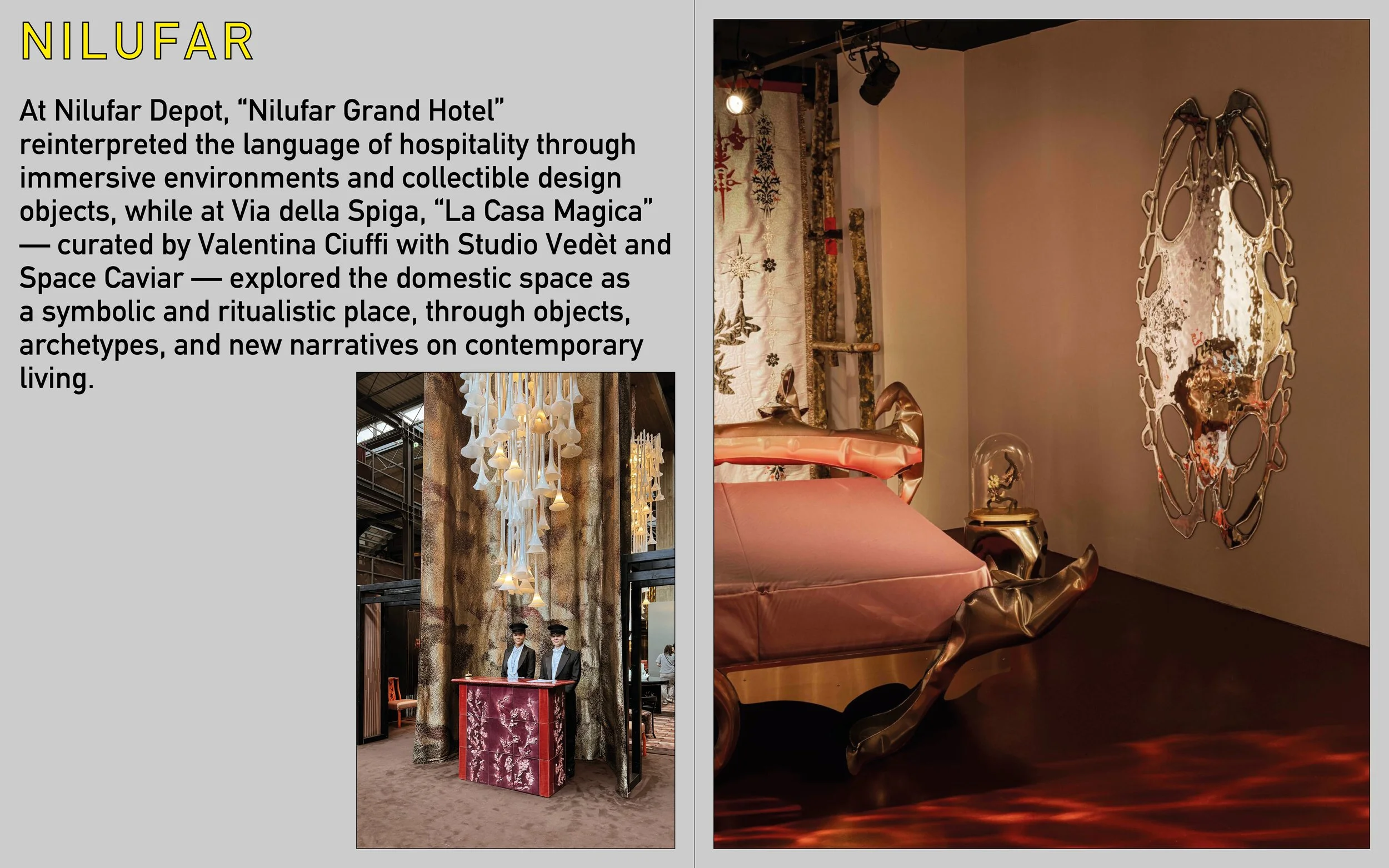
Nilufar — Depot & Via della Spiga
Nina Yashar spread her curatorial vision across two addresses this year, each operating at a different register. At Nilufar Depot, “Nilufar Grand Hotel” reinterpreted the language of hospitality through immersive environments and collectible design objects, while at Via della Spiga, “La Casa Magica” — curated by Valentina Ciuffi with Studio Vedèt and Space Caviar — explored the domestic space as a symbolic and ritualistic place, through objects, archetypes, and new narratives on contemporary living. “With Nilufar Grand Hotel, I wanted to imagine a place that doesn’t exist, yet feels profoundly real,” explained Yashar — a sentiment that captured the dual ambition of both shows: one theatrical, one intimate, but equally rigorous in their curatorial conviction.
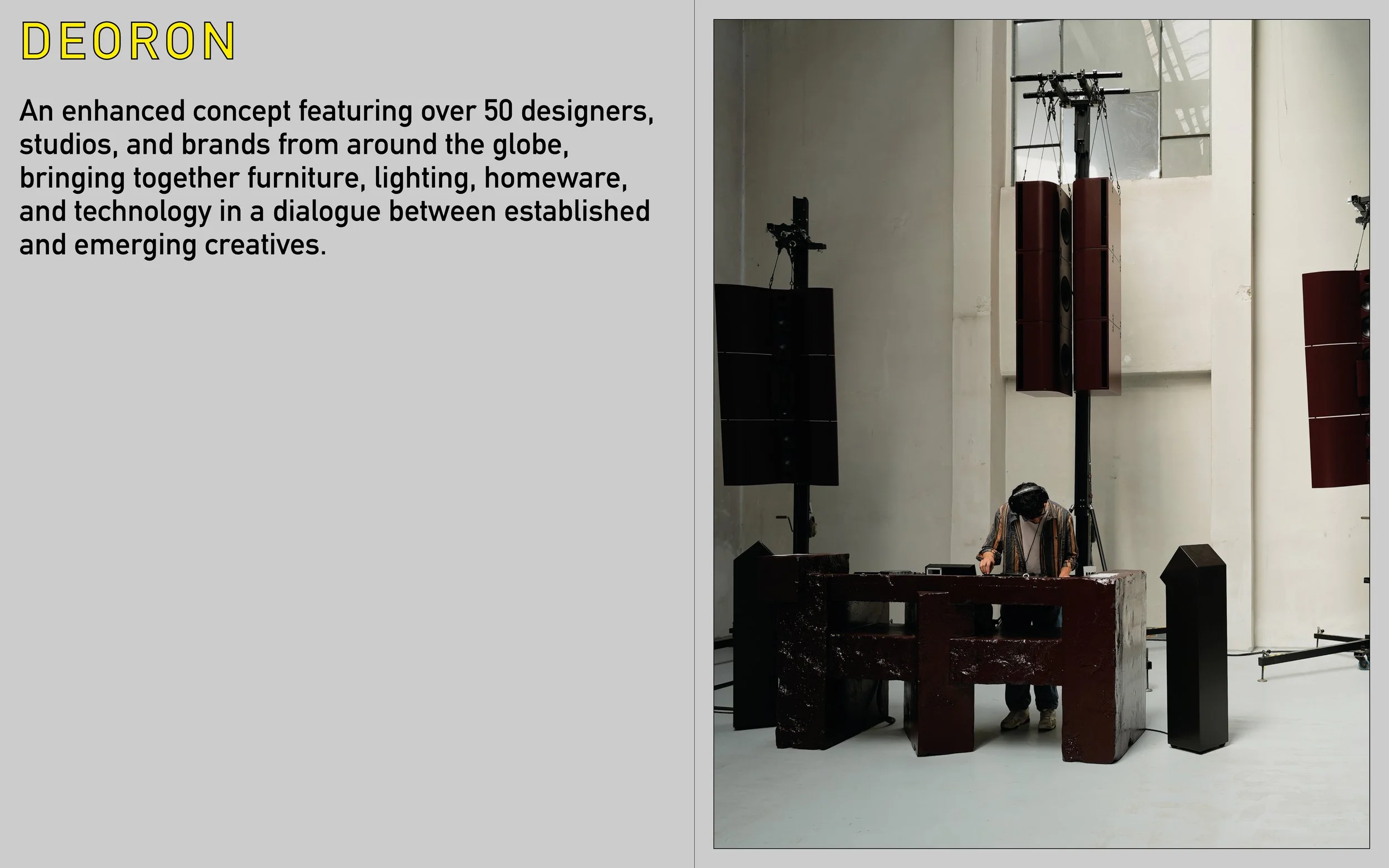
Deoron — Porta Venezia
Building on the success of its inaugural event during MDW 2025, Deoron returned with an enhanced concept featuring over 50 designers, studios, and brands from around the globe, bringing together furniture, lighting, homeware, and technology in a dialogue between established and emerging creatives. The exhibition occupied a former ball-bearings factory in Porta Venezia — opened to the public for the first time — where the industrial bones of the space became an active participant in the presentation. What distinguishes Deoron is its focus on experience: rather than a conventional exhibition, it encourages direct interaction with the works, with sound and architecture woven into a unified narrative alongside a programme of listening sessions, daily events, and a bar that activates the space as a social platform.
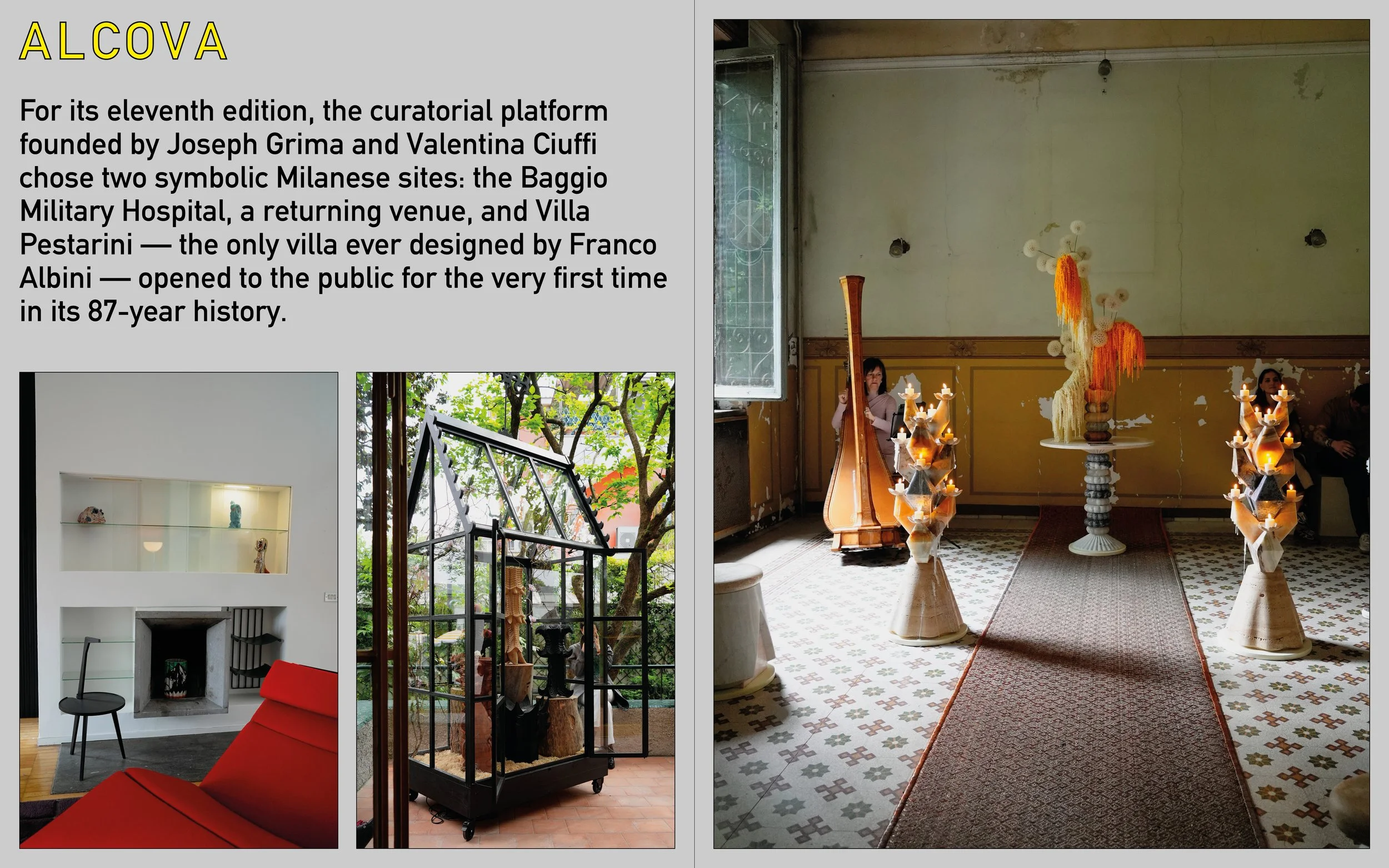
Alcova — Baggio Military Hospital & Villa Pestarini
For its eleventh edition, the curatorial platform founded by Joseph Grima and Valentina Ciuffi chose two symbolic Milanese sites: the Baggio Military Hospital, a returning venue, and Villa Pestarini — the only villa ever designed by Franco Albini — opened to the public for the very first time in its 87-year history. Glass-block façades, a low-tread marble staircase, custom-designed furniture, sliding partitions, and large windows overlooking the garden: all the elements Albini envisioned have remained intact, making it a miraculous case of preservation rare in the world of private residences. At Baggio, Alcova unlocked a sequence of previously inaccessible spaces — from a disused church and its former rectory to a historic archive — inviting a more considered reading of a site where built form and vegetation have been quietly interwoven for decades.
Delvis Unlimited — Via Fatebenefratelli 9
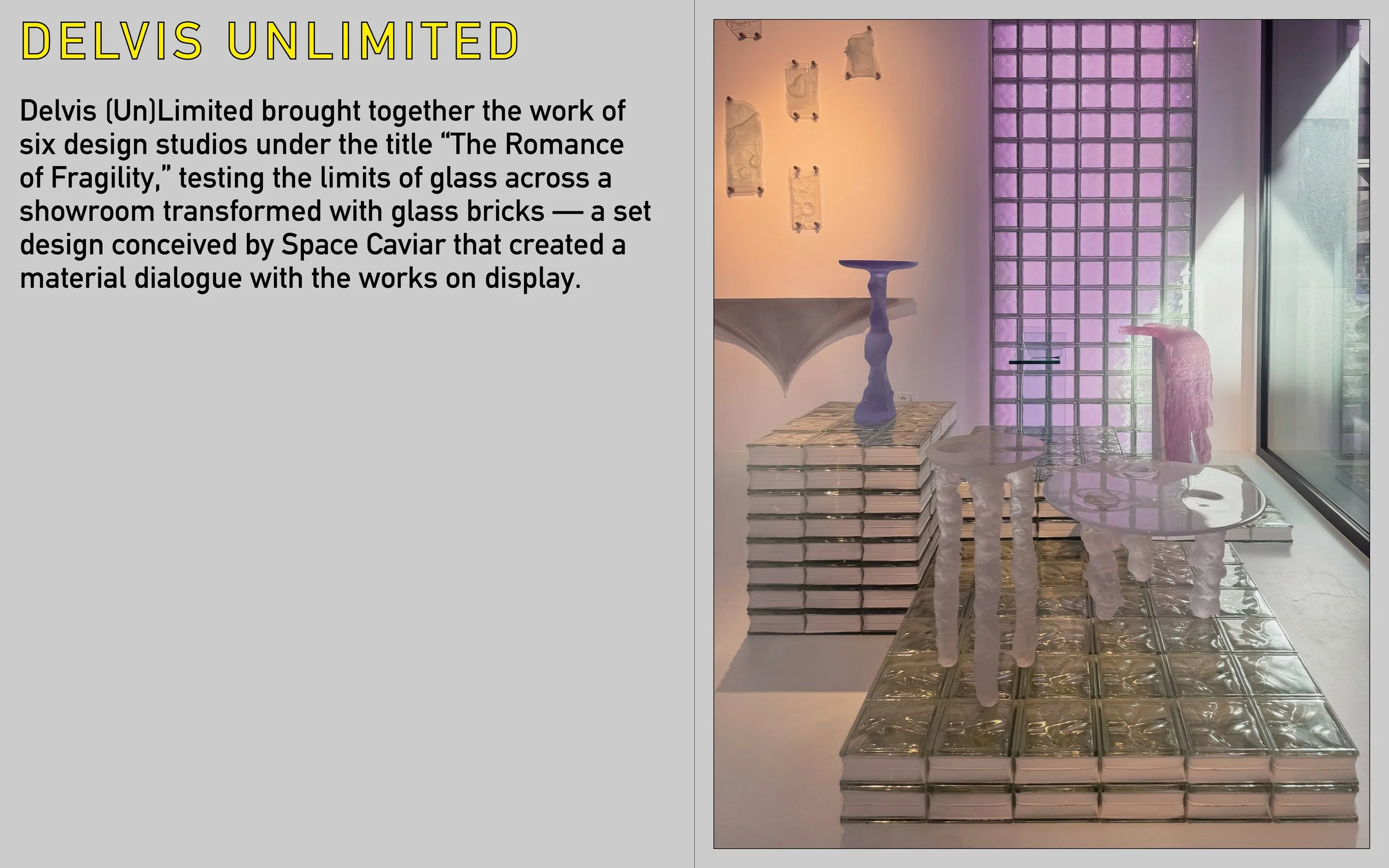
During Milan Design Week 2026, Delvis (Un)Limited brought together the work of six design studios under the title “The Romance of Fragility,” testing the limits of glass across a showroom transformed with glass bricks — a set design conceived by Space Caviar that created a material dialogue with the works on display. Works by international designers including Inderjeet Sandhu, Maria Tyakina, and Tino Seubert challenged conventional perceptions of the material, from pieces sculpted to echo stone to others melted into liquid-like casts, each one pushing glass’s limits and stereotypes. Seubert’s Ferric Glass lights — fitted with stainless-steel spider hinges and retro coiled wires — were a particular standout, proof that a material associated with fragility can carry considerable structural and conceptual weight.
Jil Sander × Apartamento — Via Luca Beltrami 5
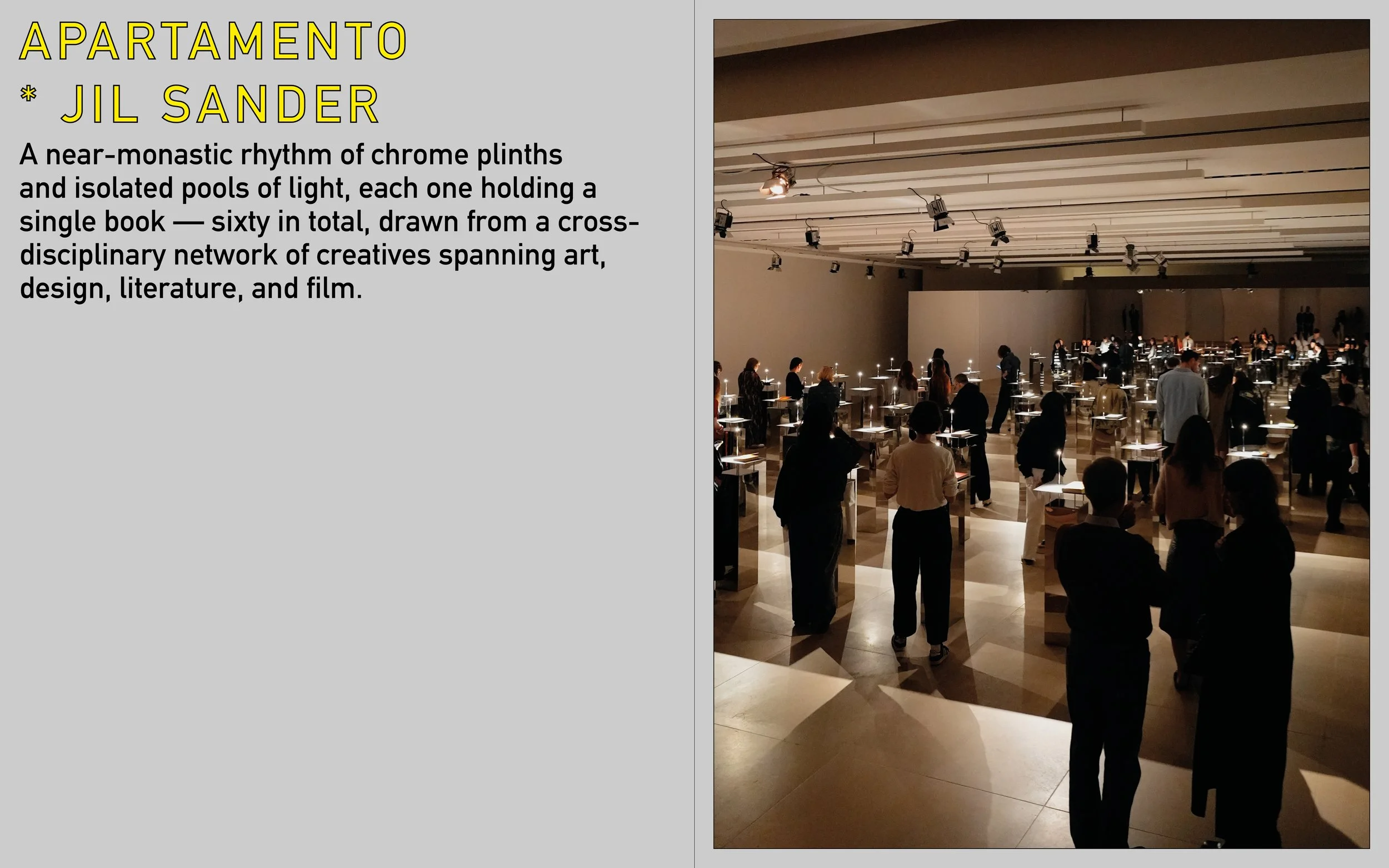
Under the direction of Simone Bellotti, the brand’s Milan headquarters was stripped back to a near-monastic rhythm of chrome plinths and isolated pools of light, each one holding a single book — sixty in total, drawn from a cross-disciplinary network of creatives spanning art, design, literature, and film. Visitors booked an appointment to handle and read the books using provided white gloves — a quiet souvenir they could keep as a reminder of the experience — in what amounted to a ceremonial slowing-down in the middle of the week’s relentless pace. For Bellotti, the project was not a departure but a return: “The brand was always connected to culture — literature, photography, architecture, design” — a statement that reframes minimalism not as aesthetic reduction, but as intellectual focus.
Muller Van Severen × Apartamento — Ordet, Via Filippino Lippi 4
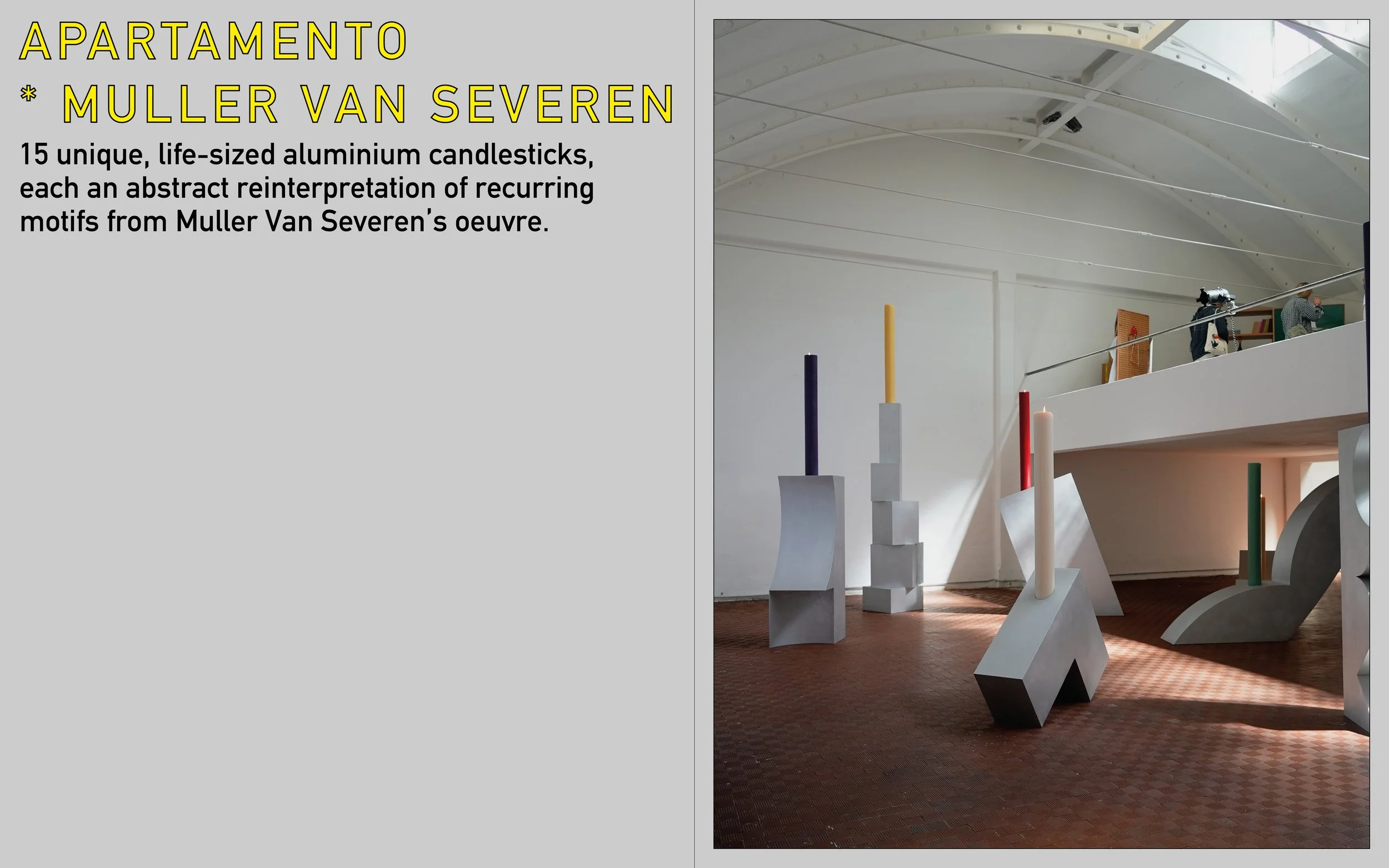
To mark fifteen years of practice, Muller Van Severen teamed up with Apartamento for a new monographic book — titled A Lot of Work — and a special exhibition, Silhouettes: Celebrating 15 Years, presented in partnership with Tim Van Laere Gallery at the Ordet arts space. The exhibition presented 15 unique, life-sized aluminium candlesticks, each an abstract reinterpretation of recurring motifs from Muller Van Severen’s oeuvre, alongside shapes that emerged from the earlier individual practices of Fien Muller and Hannes Van Severen: chairs, cabinets, lamps, vases, and sculptural structures. As the candles burned throughout the week, the pieces gradually transformed — introducing time as a material and turning an anniversary show into something that felt less like a retrospective and more like a proposition.
Convey — Via San Senatore 10
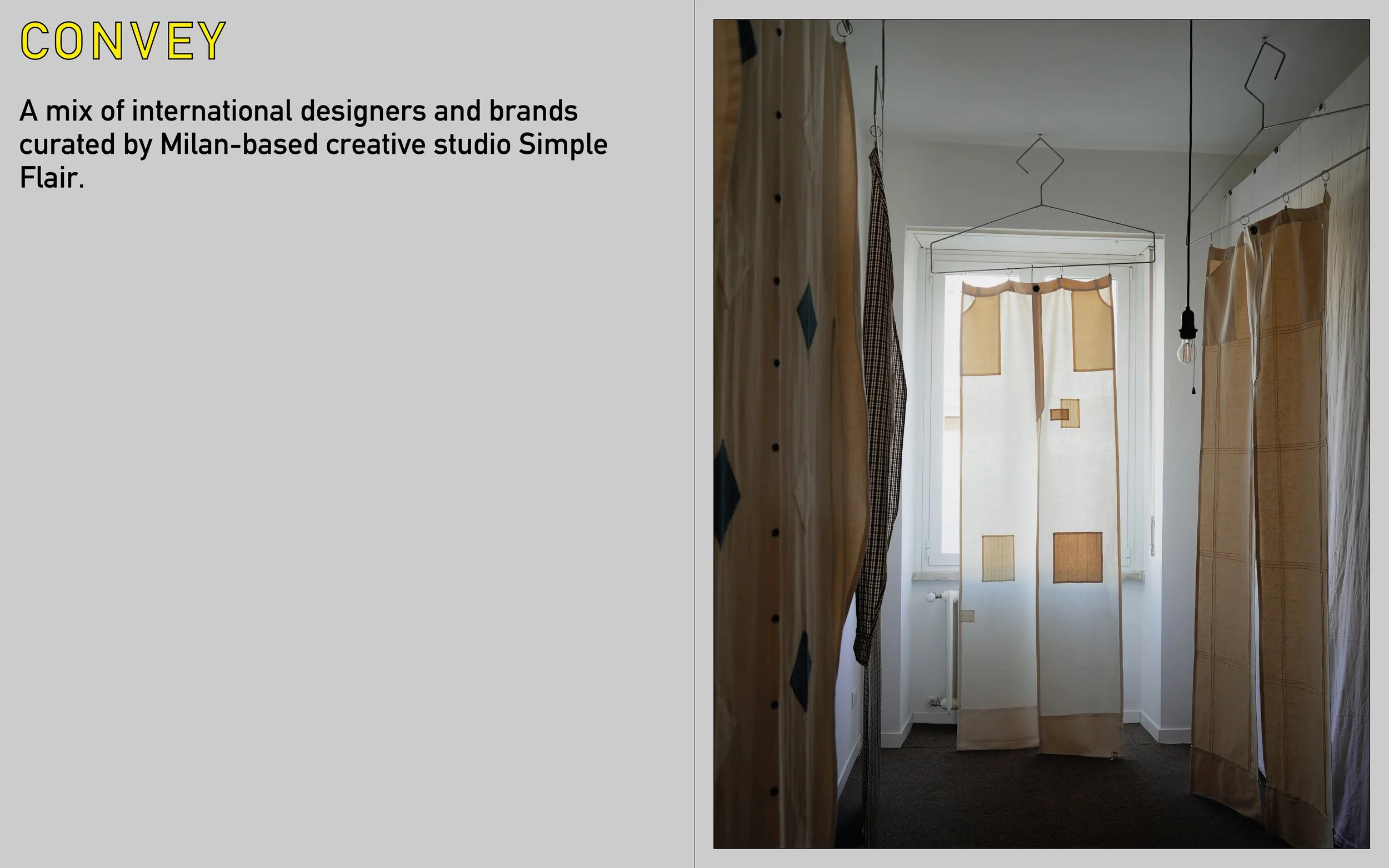
Following its debut the previous year, group show Convey took over a historic building at Via San Senatore 10 — designed by Ottavio Cabiati and Luigi Brambilla in 1958 — playing host to a mix of international designers and brands curated by Milan-based creative studio Simple Flair. For 2026, the show turned the building into a dense, multi-room exhibition where each space introduced a different designer or brand, with distinct aesthetics unfolding floor by floor and reinforcing a collective, multi-author approach to design. On the panoramic rooftop terrace, Ege Carpets presented a new earth-toned collection curated by Gabriella Khalil, the terrace doubling as a social hub throughout the week — one of the more genuinely convivial spots in an increasingly programmed city.
Bocci — Via Giuseppe Rovani 20
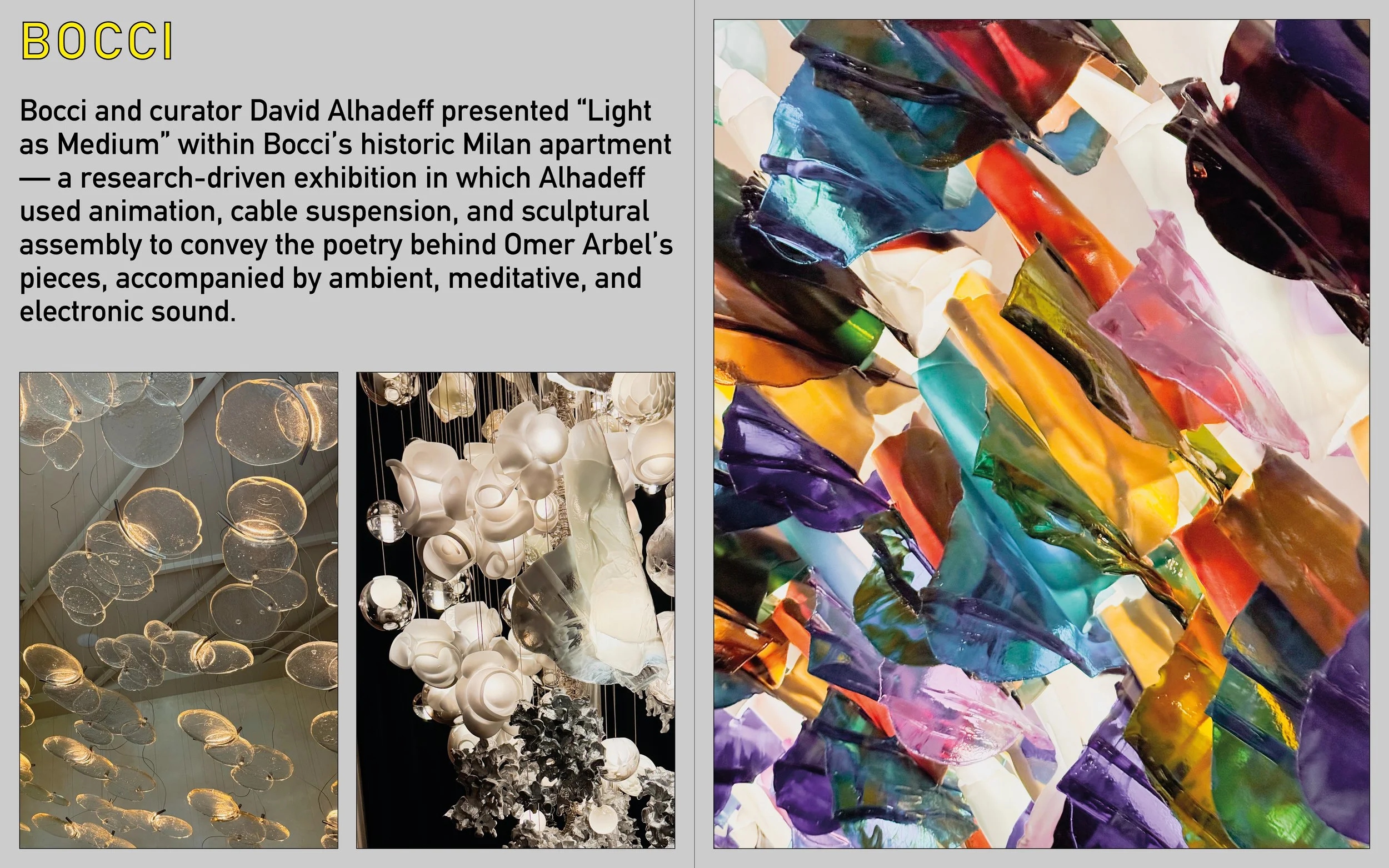
Marking their second collaboration, Bocci and curator David Alhadeff presented “Light as Medium” within Bocci’s historic Milan apartment — a research-driven exhibition in which Alhadeff used animation, cable suspension, and sculptural assembly to convey the poetry behind Omer Arbel’s pieces, accompanied by ambient, meditative, and electronic sound. In the main hallway, 147 Wave — composed of 200 lit pieces of sheet glass in alternating colors and forms — created a continuous, undulating composition, while 28 Stream traced the stairwell with cascading bands of pendant lights that descend, gather, and shift direction. The domestic setting was stripped back into a sequence of immersive encounters — a spatial argument about perception that felt genuinely architectural, and one of the week’s most quietly radical gestures.
Andrea Branzi — Triennale Milano, Viale Alemagna 6
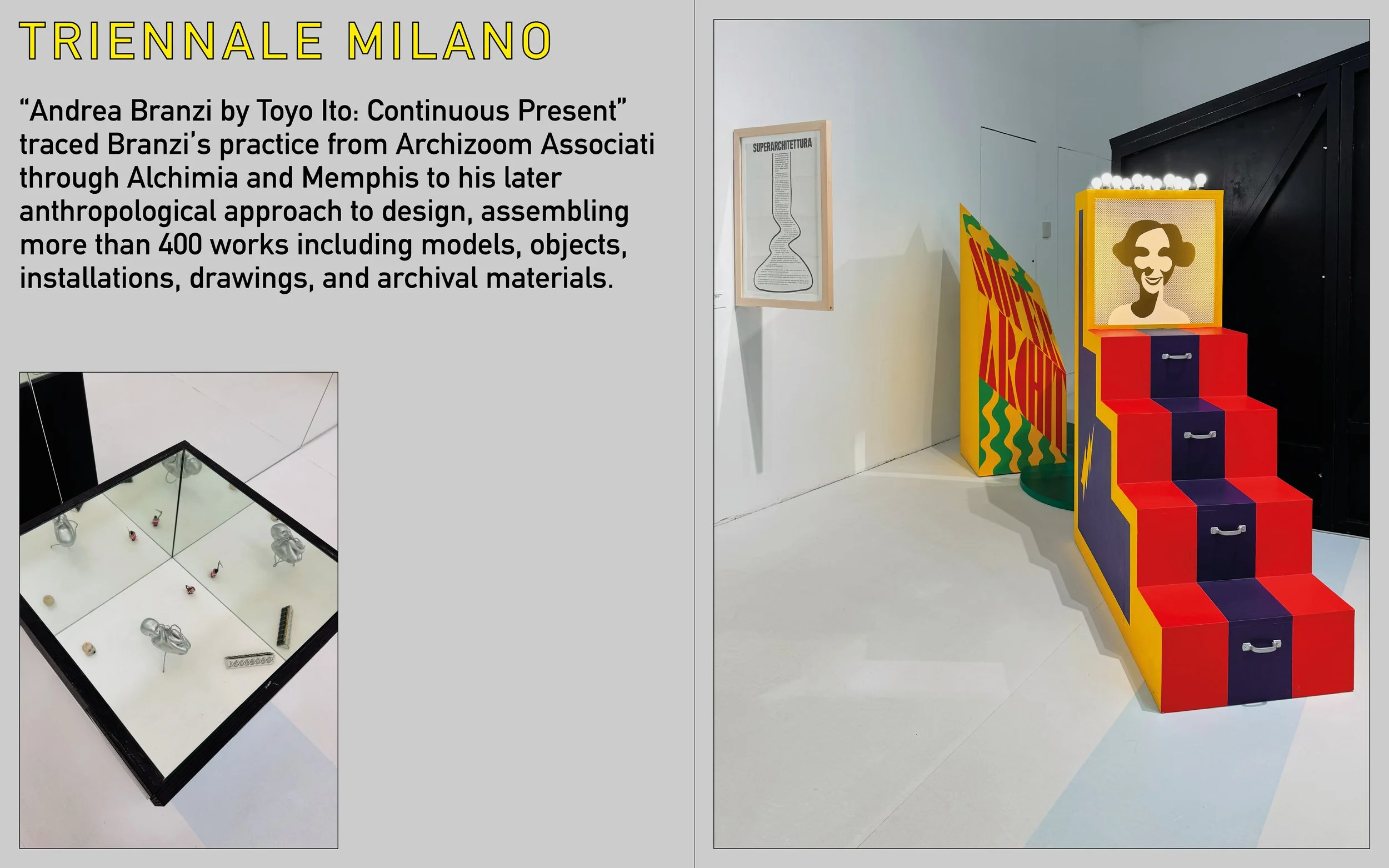
Conceived by Pritzker Prize laureate Toyo Ito and curated by Nina Bassoli and Michela Alessandrini, “Andrea Branzi by Toyo Ito: Continuous Present” traced Branzi’s practice from Archizoom Associati through Alchimia and Memphis to his later anthropological approach to design, assembling more than 400 works including models, objects, installations, drawings, and archival materials. The exhibition takes shape as an open system structured through thematic clusters that reflect the hybrid, non-linear nature of Branzi’s thinking, described by Ito as a “continuous present” — a condition in which past and future overlap within an uninterrupted flow of ideas. On view through October 4, this is not something to rush through during Design Week — it is one of the few shows that will reward a return visit once the city has quieted.
10 Corso Como
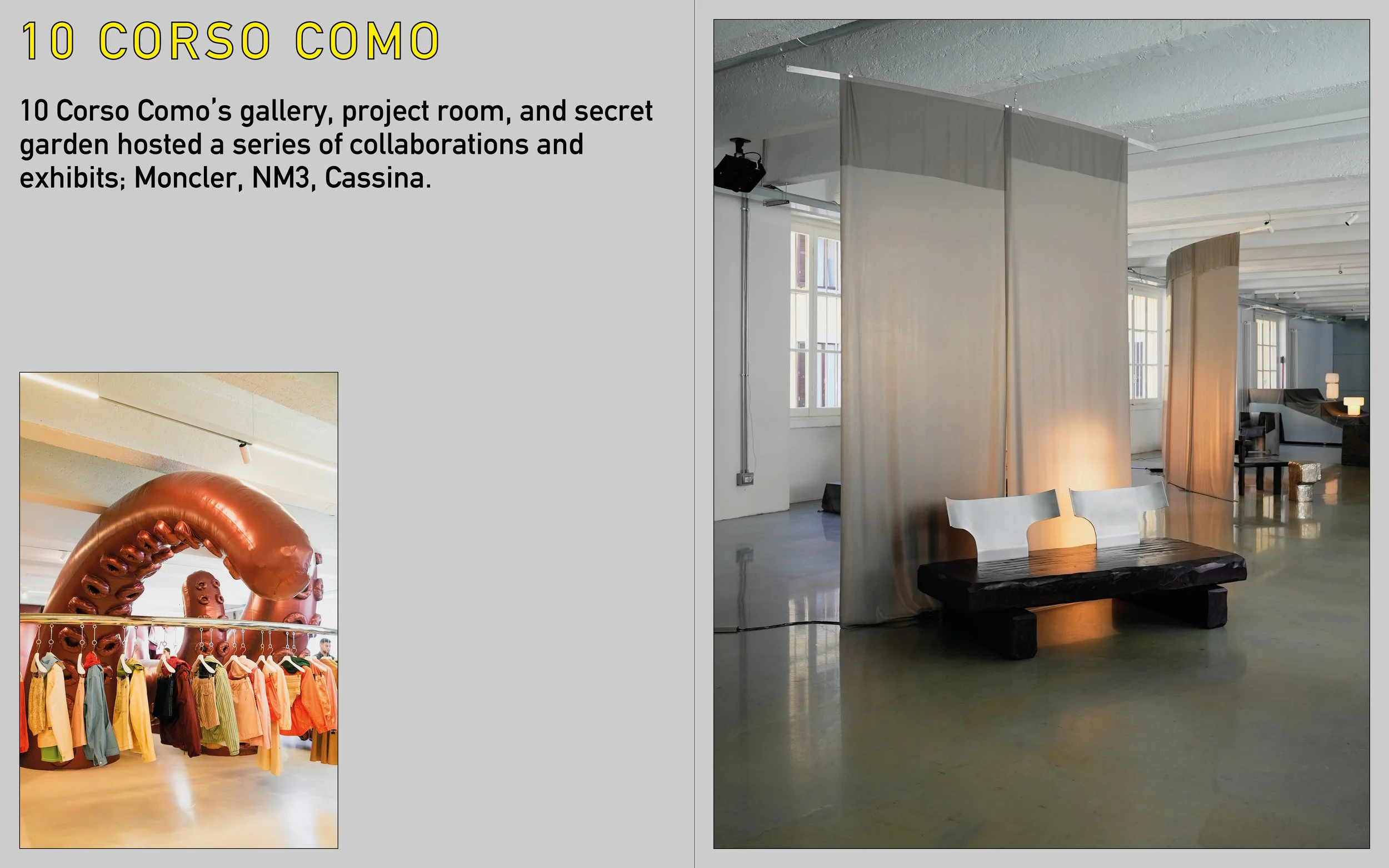
10 Corso Como’s gallery, project room, and secret garden hosted a series of collaborations and exhibits during the week, including the installation “Sonnambulo Lucido” by Milan-based design collective Imperfettolab. Moncler’s inflatable octopus loomed over the courtyard in one of the week’s more surreal gestures, while NM3 and Cassina contributed installations that made the space feel both playful and considered. The garden — shaded, unhurried, and reliably removed from the week’s more frenetic circuits — remained what it always is: one of the best places in Milan to simply stop.
Issey Miyake — Via Bagutta 12
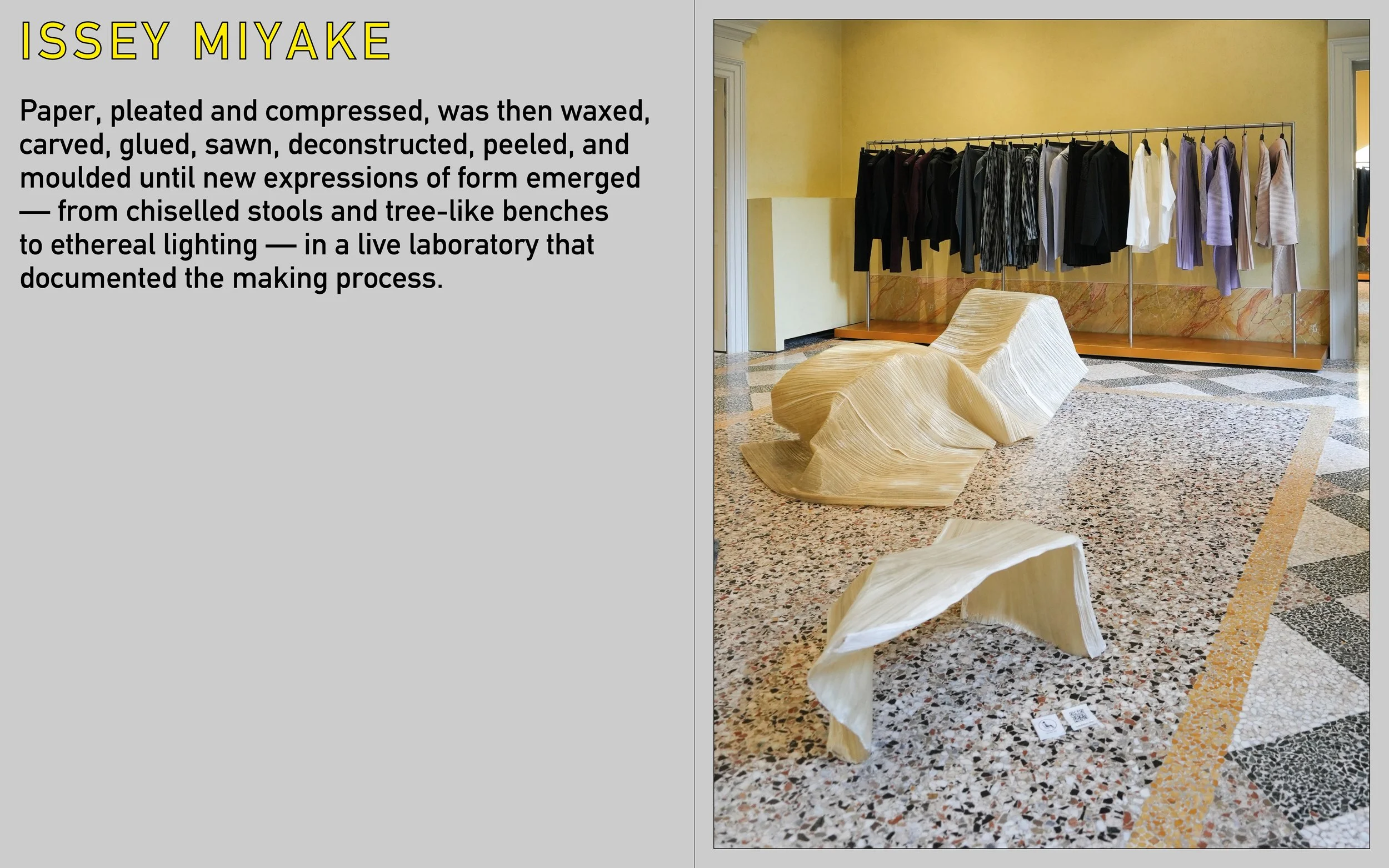
Conceived by Satoshi Kondo of MIYAKE DESIGN STUDIO in collaboration with Spanish architecture office Ensamble Studio, “The Paper Log: Shell and Core” centred on the creative reuse of compressed paper rolls — the byproduct of the house’s signature garment pleating process — each 80 cm cylinder reimagined as raw material for furniture and sculptural objects. Paper, pleated and compressed, was then waxed, carved, glued, sawn, deconstructed, peeled, and moulded until new expressions of form emerged — from chiselled stools and tree-like benches to ethereal lighting — in a live laboratory that documented the making process throughout the week. Running through May 5, it was one of the few Design Week presentations worth returning to after the city had quieted — a reminder that the best design thinking rarely needs an audience of thousands to make its point.
Milan Design Week 2026 ran April 20–26. Several of the exhibitions mentioned remain on view.