A-Z Design Lexicon: Gianfranco Frattini
A-Z DESIGN LEXICON is a curated archive of the names, ideas, and works defining the design landscape.
“Every element, down to the smallest object, was designed in relationship to the overall scheme.”
Gianfranco Frattini is not a designer you discover all at once. Gianfranco Frattini worked for fifty years at the centre of Italian design without ever seeking the foreground. His objects offer themselves without insistence — slowly, through proportion, through the quality of a joint, through the way a surface receives light. He was, in the fullest sense, a designer’s designer: someone whose influence is more felt than cited, whose restraint is itself a form of argument.
Frattini was born in Padua in 1926 and trained at the Politecnico di Milano, where he studied under Gio Ponti — a mentor whose shadow was long and whose studio was, in the early 1950s, one of the most generative rooms in European design. It was there that Frattini met Cesare Cassina, the entrepreneur who would become both patron and lifelong friend. When a competition entry — a small lounge chair — failed to win, it was Cassina who suggested putting it into production regardless. The gesture was prescient. It inaugurated a collaboration that would last decades and produce some of the most enduring furniture of the Italian postwar period.
In 1956, Frattini co-founded the ADI — the Associazione per il Disegno Industriale — alongside many of the figures who would define the Made in Italy movement. He opened his own studio the same year. But where others in his generation moved toward provocation or spectacle, Frattini moved inward — toward craft, toward material, toward the specific intelligence that wood and steel and light each carry within them. His closest professional friendship, with the master cabinetmaker Pierluigi Ghianda, was not incidental to his practice. It was the practice. Design, for Frattini, was inseparable from the knowledge of how things are made.
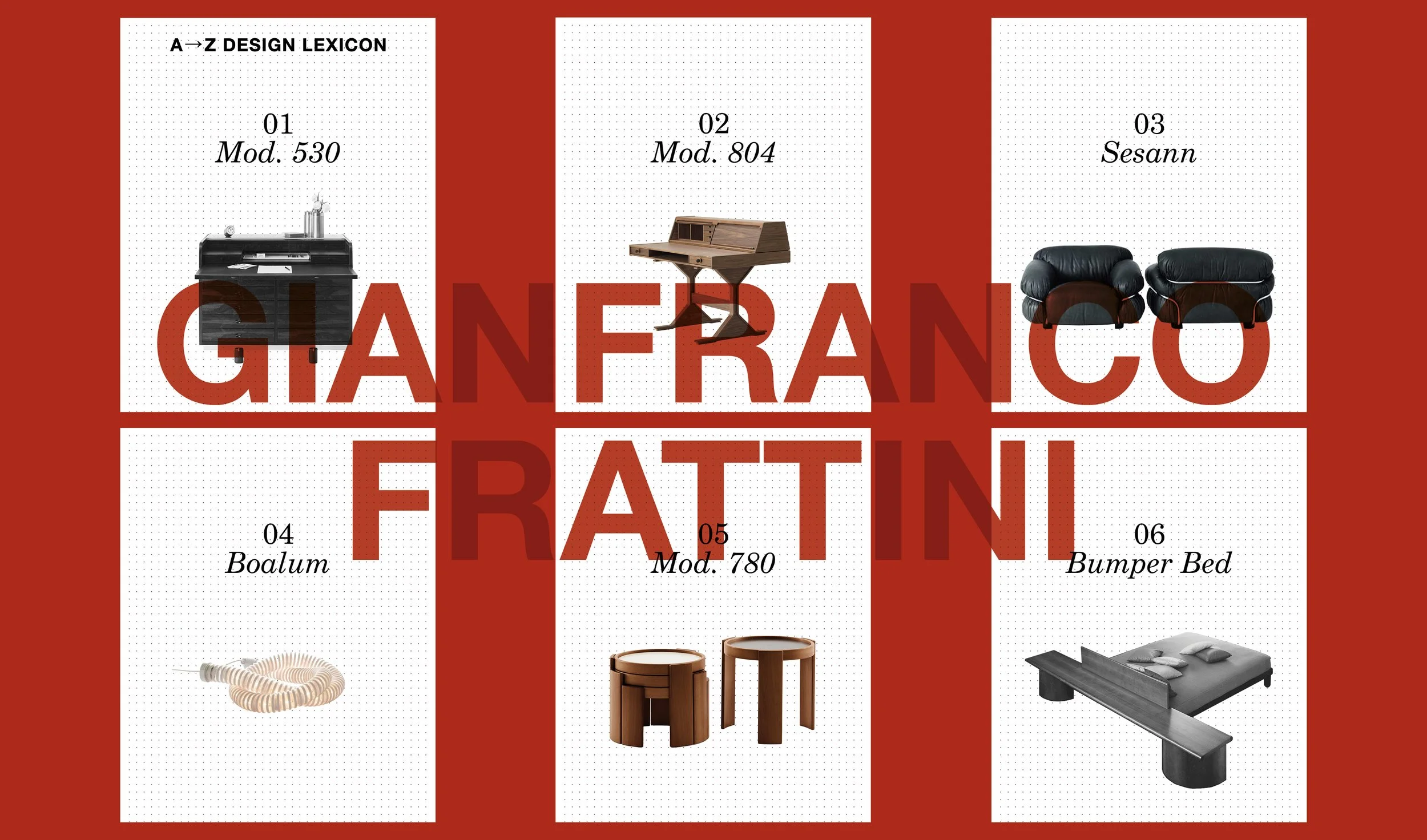
Mod. 530 (1957, Bernini)
The 530 desk is an exercise in considered silence. At a time when Italian design was discovering the expressive possibilities of plastic and the dramatic gesture, Frattini turned to rosewood and a vocabulary of precision joinery. The roll-top mechanism — activated by a leather-inlaid writing surface — conceals a perfectly organised interior: glass shelves, compartments calibrated to use. It is a piece of furniture that thinks. The 530 belongs to the tradition of the architect-designed desk, the object that takes seriously the idea that how one works is shaped by what one works at.
Mod. 804 (1961, Bernini)
If the 530 is about enclosure, the 804 is about disclosure. A writing desk stripped to its essential geometry — a precise rectangular top, legs of refined proportion, a surface that asks nothing of you except that you sit and begin. Frattini’s collaboration with Bernini produced some of his most restrained work, and the 804 is perhaps the purest expression of that restraint: the desk as an act of trust in the user, a surface that makes no argument except the argument of clarity.
Sesann (1970, Cassina / Tacchini)
The Sesann arrives as a kind of paradox: a sofa that is simultaneously architectural and deeply soft. A tubular chrome cage — visible, structural, unapologetic — holds a body of cushioning so generous that the effect is one of complete envelopment. It should not work as well as it does. The tension between the hardness of the frame and the softness of what it contains is precisely the point: Frattini understood that comfort is not the absence of structure, but its consequence. Cassina produced it from 1970; Tacchini reintroduced it in 2015, a sign of how fully the design had outlasted its moment.
Boalum (1970, Artemide) — with Livio Castiglioni
The Boalum is the exception in Frattini’s catalogue — the piece that abandons the language of craft and precision for something closer to poetry. Designed with his friend and colleague Livio Castiglioni, it is a luminous tube of translucent plastic, flexible, extendable, coilable into any form the user chooses. It resembles — and the name makes this explicit — a boa constrictor made of light. The Boalum is now in the permanent collections of the Smithsonian and MoMA, monuments to a moment when two designers asked what a lamp could be if it had no fixed form. The answer was both playful and serious, as the best collaborations tend to be.
Mod. 780 (1976, Cassina)
The 780 series of nesting tables is the object that most clearly reveals Frattini’s understanding of the relationship between a single thing and a set of things. Four cylindrical tables, each a different height, each with a reversible top in black and white laminate — stackable into a single column when not in use. The wit is quiet: a problem of storage solved so elegantly that the solution becomes the aesthetic. Wood, lacquer, proportion. Nothing more is needed, and nothing more is offered.
Bumper Bed (1976)
The Bumper Bed occupies a different register from the rest of Frattini’s catalogue — more tactile, more overtly sensuous, more willing to let softness be the subject rather than the consequence. The padded headboard wraps around the bed frame with a continuity that refuses the usual separation between structure and upholstery. There are no hard edges where you would expect them. The result is an object that feels resolved from the inside out, as if the form had been arrived at by the body rather than the drawing board. In the Bumper, Frattini demonstrated that his discipline was not austerity — it was control, and control, in the right hands, can produce something approaching tenderness.
What holds these six works together is not a signature aesthetic but a consistent attitude: that every object exists in relation to something else — to the body that uses it, the room that contains it, the hand that made it. Frattini called this total design, a belief that no element of a space is incidental, that even the ceiling is a surface deserving of thought. His furniture enacts this belief quietly, without declaration. It does not ask to be looked at. It asks, more modestly and more demandingly, to be lived with — and it rewards that proximity with a warmth that more expressive objects rarely achieve.