A-Z DESIGN LEXICON: Poul Henningsen
A-Z DESIGN LEXICON is a curated archive of the names, ideas, and works defining the design landscape.
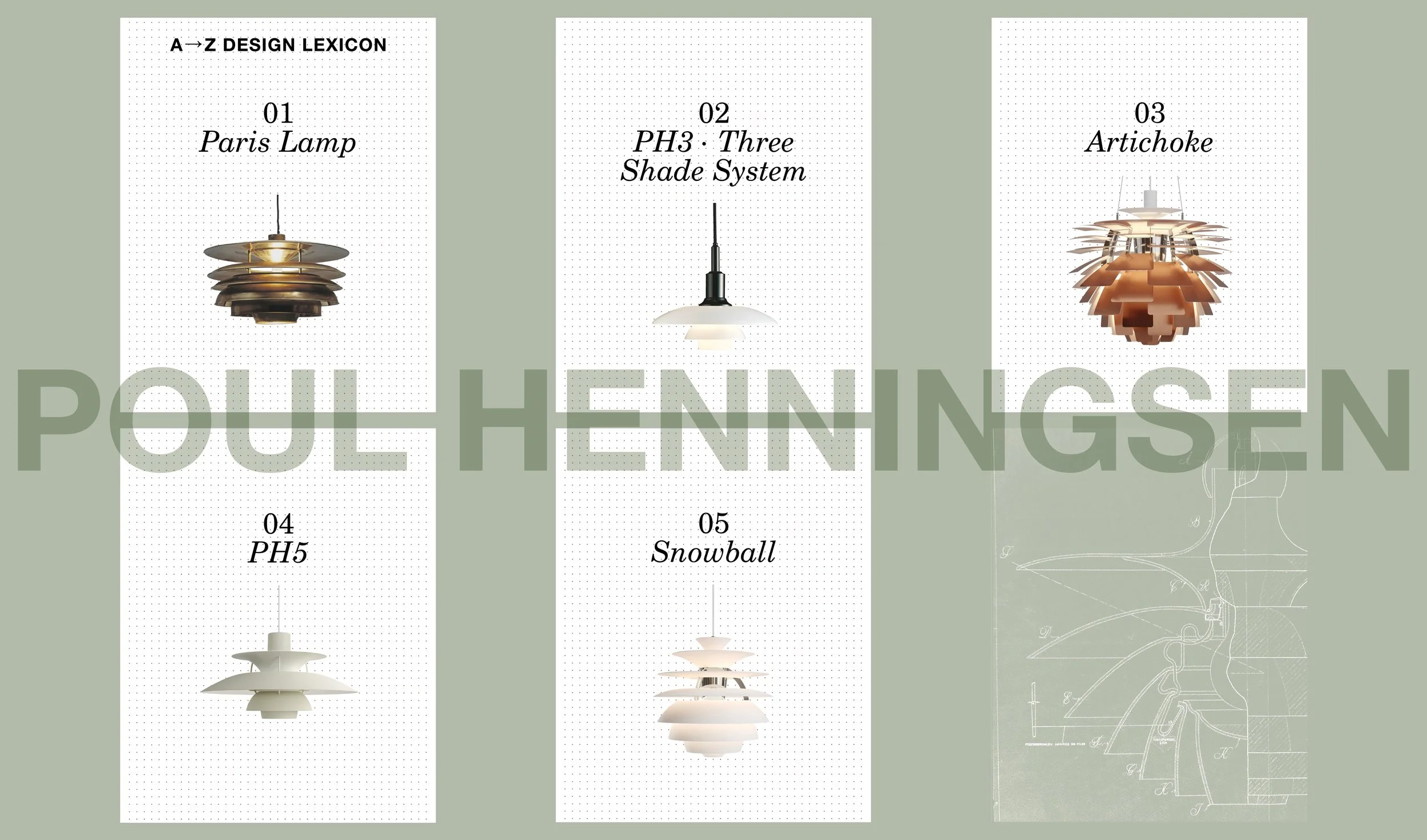
“The whole secret is to place the light where it’s needed and to hide the source from the eye.”
Most designers give us objects to look at. Poul Henningsen gave us something harder to see and impossible to ignore: the quality of light in the room. Before him, the electric bulb was a small act of violence; a naked, glaring point of brightness that Copenhagen’s newly electrified homes had accepted as the price of modernity. Henningsen refused to accept it. He spent his life on a single, almost obsessive question: how do you illuminate a space without ever letting the eye fall on the source? The answer he arrived in a patient, mathematical and deeply humane manner, as he changed the way the modern world understands what light is for.
Born in Copenhagen in 1894 to the writer Agnes Henningsen and the satirist Carl Ewald, PH grew up in an intellectual, argumentative household and never quite stopped arguing. He trained as an architect but never graduated, drifting instead toward journalism, cultural criticism, songwriting, and the problem that would define him: light. In 1925 he began a collaboration with the lighting manufacturer Louis Poulsen that would last until his death in 1967. This was one of the most productive partnerships in the history of design. He was a man of the political left, a critic of cultural conservatism, forced to flee to Sweden during the German occupation. His design practice was never separate from his politics. Good light, for Henningsen, was a democratic right; something every home deserved, not a luxury for the few.
The Paris Lamp (1925)
The beginning of everything. Henningsen presented the Paris Lamp at the International Exhibition of Modern Decorative and Industrial Arts in Paris in 1925, the same exhibition that gave Art Deco its name. It won the gold medal. Made of silver, built from six shades, it was the first public demonstration of the principle that would occupy him for the rest of his life: that carefully arranged shades could reflect and redirect light, softening it, hiding the bulb, sending illumination exactly where it was wanted. An early model was sold at an auction in 2016 for £87,500. But the Paris Lamp’s real value was never monetary. It was the proof of concept, the moment the idea became visible, and the beginning of the partnership with Louis Poulsen that would propel it forward.
The Three-Shade System (1926)
If the Paris Lamp was the demonstration, the Three-Shade System was the theory made rational. Developed out of a lamp Henningsen designed for the Forum building in Copenhagen, the system reduced his insight to a reproducible logic: three shades, their diameters following precise mathematical proportions, arranged so that the upper shade reflects half the light and the middle and lower shades a quarter each. Based on a logarithmic spiral, the geometry meant that no matter where you stood, you never saw the bulb — only warm, even, glare-free light. From this single system came a thousand variations: pendants, table lamps, floor lamps, chandeliers, in every size, material and colour. It is one of the rare cases in design where a piece of pure mathematics became a household object, and where the object never needed to be improved because the mathematics were right the first time.
PH Artichoke (1958)
The masterpiece. Designed in 1958 for the Langelinie Pavillonen restaurant in Copenhagen, the Artichoke (Kogle in Danish) took Henningsen’s principle to its most sculptural extreme. Seventy-two copper leaves, arranged in twelve rows across the surface of a sphere, each positioned so that from any angle, at any height, the bulb at the centre remains completely hidden. The light escapes only through the gaps between the overlapping leaves, softened and warmed by their curved undersides. It is at once a rigorous solution to the glare problem and a piece of pure poetry, almost a hanging sculpture that happens to be a lamp. Still assembled entirely by hand at Louis Poulsen, it remains the most spectacular expression of everything Poul Henningsen believed: that function, pursued far enough, becomes beauty.
PH 5 (1958)
The democrat. If the Artichoke is Henningsen’s aristocrat, the PH 5 is his everyman. It is the lamp that hangs over more Danish dining tables than any other object in the country’s design history. Introduced the same year as the Artichoke, it was designed to solve a practical problem: light bulbs kept changing shape and size, and Henningsen wanted a pendant that would work regardless of what bulb was screwed into it. The result was a fully enclosed, glare-free fixture that needed no adjustment and no thought. One would simply hung it and forgot it, and the light was always right. The small coloured shades inside, tuning the spectrum toward warmth, were a characteristic Henningsen touch: an invisible refinement, felt rather than seen. The PH 5 is the purest proof that his greatest designs were the ones nobody noticed they were using.
PH Snowball (1958)
The poet. Also introduced in that remarkable year of 1958, the Snowball is the most delicate of Henningsen’s great pendants. Eight shades, alternating between metal and matte-white surfaces, layered into a form that seems to hover in the air like the thing it is named for. From below it glows evenly; from the side it dissolves into a soft, floating geometry. Where the Artichoke overwhelms and the PH 5 disappears into daily use, the Snowball simply enchants — the work of a man who had solved the technical problem so completely that he was now free to play. It is Henningsen at his most lyrical, proof that a lifetime of rigour had earned him the right to make something purely, quietly beautiful.
What unites these five works is not a look but a conviction, that light is not decoration but experience, that the way a room is lit shapes the way a life is lived in it. Poul Henningsen never designed a lamp to be looked at. He designed each one to be looked through, or rather, to disappear — so that what you noticed was not the fixture but the warmth of the evening, the softness of the shadows, the comfort of a room that welcomed you without straining your eyes. In an age that equated progress with brightness, he understood something quieter and more radical: that the highest achievement of a light is to be felt and never seen. The bulb, hidden. The glare, gone. Only the glow remaining.