A-Z DESIGN LEXICON: Eileen Gray — E-1027

"Nowhere did we attempt to create a line or a form for its own sake; everywhere we thought of the human being, his sensibility, his needs."
There are houses that demonstrate ideas. The E-1027 is something rarer: a house that embodies a conviction. Eileen Gray designed it between 1926 and 1929 on a rocky promontory above the Mediterranean at Roquebrune-Cap-Martin, and she designed it entirely — the building, the furniture, the rugs, the lighting, the storage, the balance between interior and exterior, between sunlight and shade. Nothing was sourced. Nothing was incidental. Every object in the house was a reponse on the manner a body moves through space, how a person rests, reads, eats, thinks.
The name encoded a relationship. E for Eileen; 10 for Jean — J being the tenth letter of the alphabet — 2 for Badovici; 7 for Gray. Jean Badovici, architect himself, was Gray's lover and collaborator. As an architecture critic, he initially encouraged her to realise the project herself. The house was hers in every sense: in ambition, in execution, and in the remarkable coherence of its interior life. Le Corbusier visited E-1027 and he visited often, drawn by something he familiarised with and definetey envied. He even later painted murals on the walls defying Eillen Gray’s desire — to maintain the interior free of decoration.
What follows is not a catalogue of objects. It is an account of a total environment — one of the few in the history of modern design where architecture and furniture were conceived together, by the same mind, for the same body, in the same place.
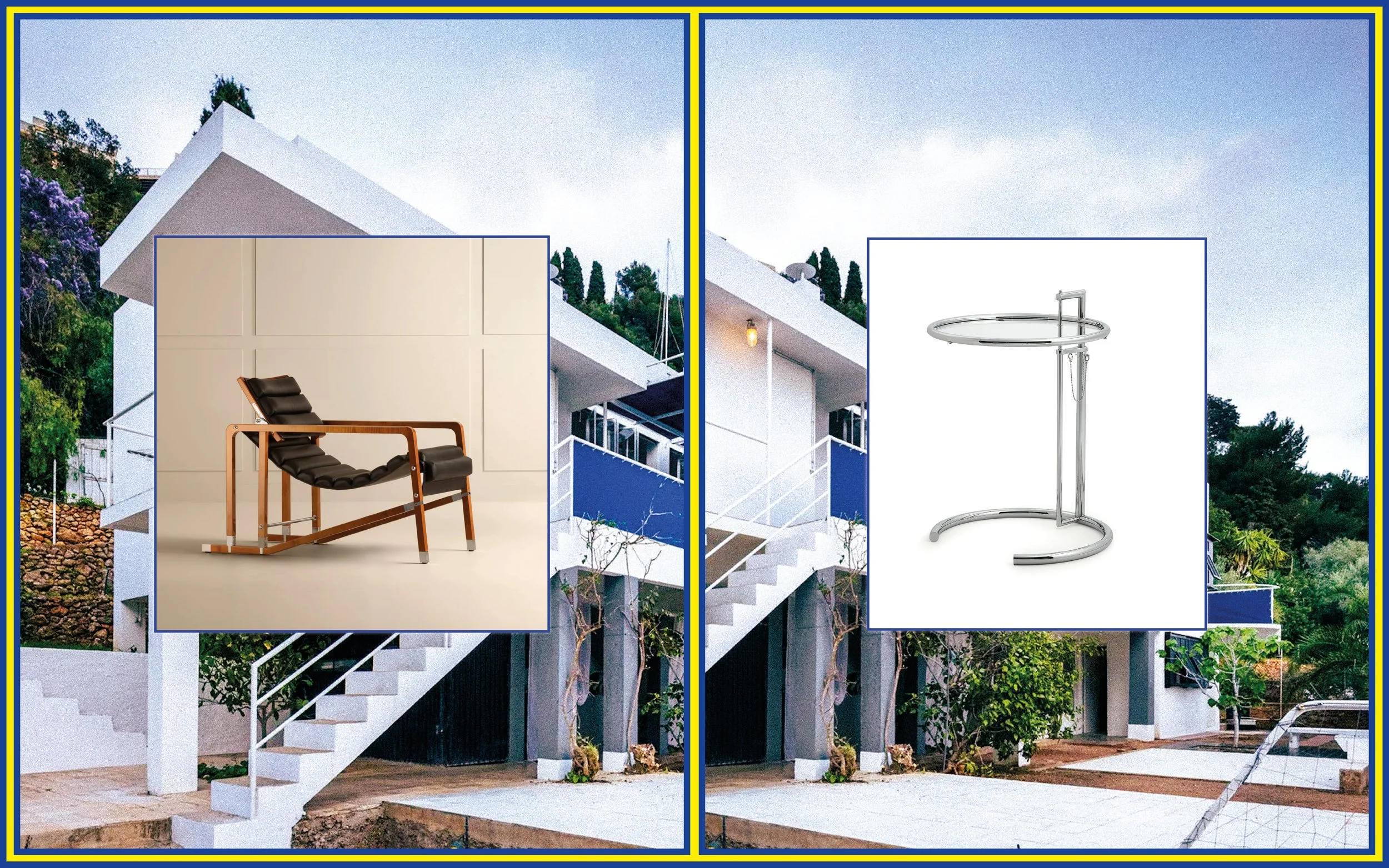
Transat Chair (1925–1927)
The name is an abbreviation — transatlantique — and it announces the source: the reclining deck chairs of the great ocean liners, those instruments of leisure that stretched across the first-class decks of the 1920s. Gray took the idea and stripped it of all romance, keeping only the logic. A sycamore frame — chosen for its flexibility and pale grain — articulates into a reclining position through chromed metal hinges of extraordinary refinement. A lacquered panel sits between the arms; a loose leather cushion completes the seat. The Transat is a chair that moves, that adjusts, that accommodates the body at different hours of the day and different states of rest. It is also, seen from any angle, a composition of complete elegance — prioritizing comfort, achieving unmatcable elegance.
Adjustable Table E-1027 (1927)
The story Gray told about this table is domestic and precise: she designed it for her sister, who liked to eat breakfast in bed without getting crumbs in the sheets. The table's base — two circular rings of tubular steel — slides under a bed frame; the height adjusts on a ratchet mechanism operated by a small chain. Glass top, chrome stem, circular foot. It is one of the most functionally intelligent objects of the twentieth century, and one of the most beautiful. Intelligence and beauty meet. MoMA acquired it for its permanent collection in 1978. It remains in continuous production. No element of it has ever needed to be revised.
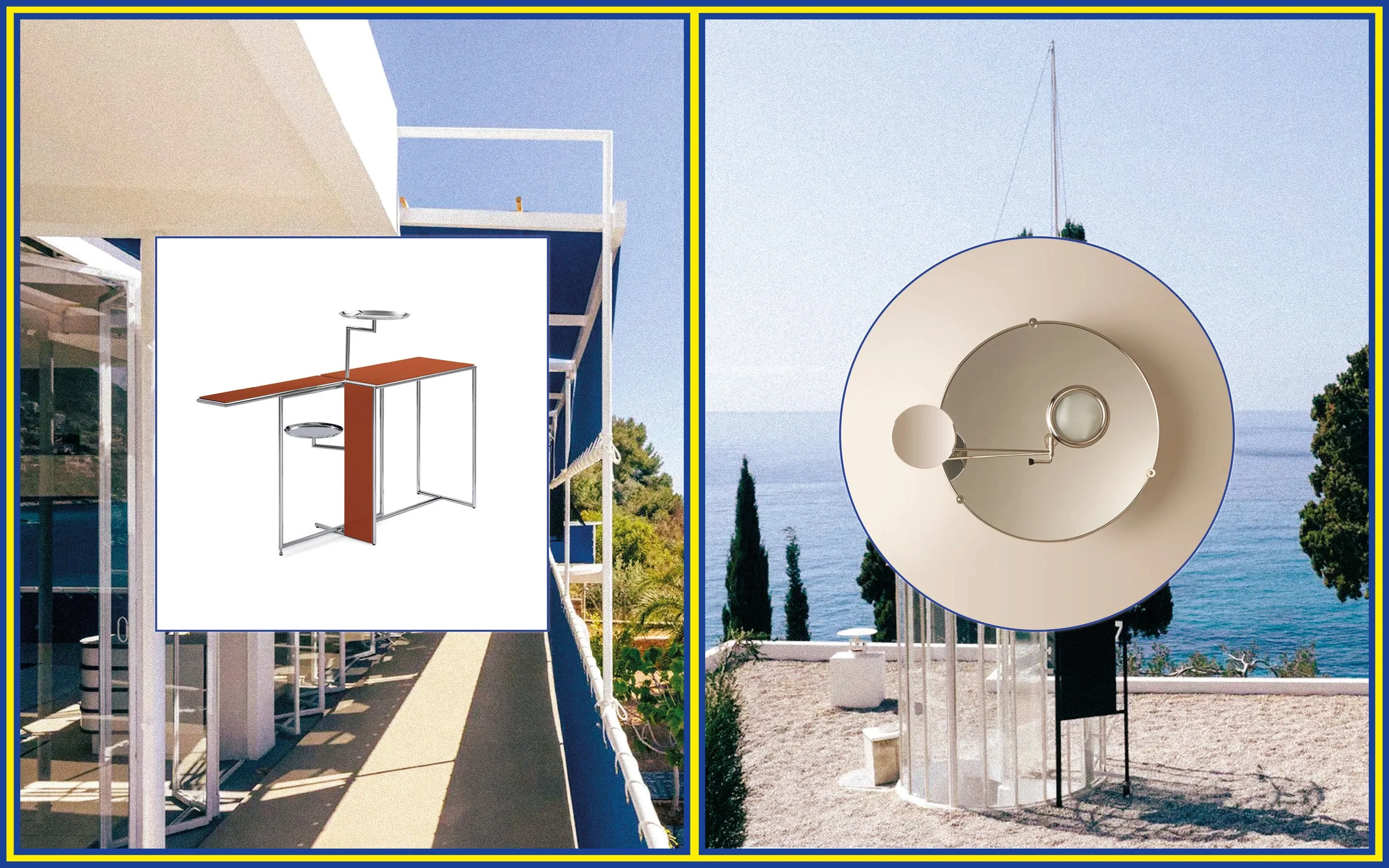
Rivoli Table (1927)
Where the E-1027 table is precise and purposeful, the Rivoli is light and sociable. A low, partially foldable table in tubular steel, it served as the tea table in the living room of E-1027 — the surface around which conversation gathered, onto which cups and books and small objects were placed and rearranged. Its folding mechanism means it can move between rooms, appear on the terrace, disappear when not needed. It is a table that understands domesticity not as a fixed arrangement but as fluid accommodation — a surface that earns its presence in a room by never insisting on it.
Satellite Mirror (1927)
The Satellite Mirror in the guest bedroom of E-1027 is mounted on an articulated arm that extends from the wall and rotates through multiple axes, allowing the mirror to be positioned at any angle the user requires. It is a piece of engineering as much as furniture — the chromed arm a small sculpture in itself, the convex glass surrounded by a ring of small light bulbs that illuminate the face from all sides. Gray designed it specifically for the guest room, understanding that a visitor in an unfamiliar space needs more flexibility than a resident. The Satellite is one of those objects that solves a problem so completely that you wonder, afterwards, how anyone managed without it.
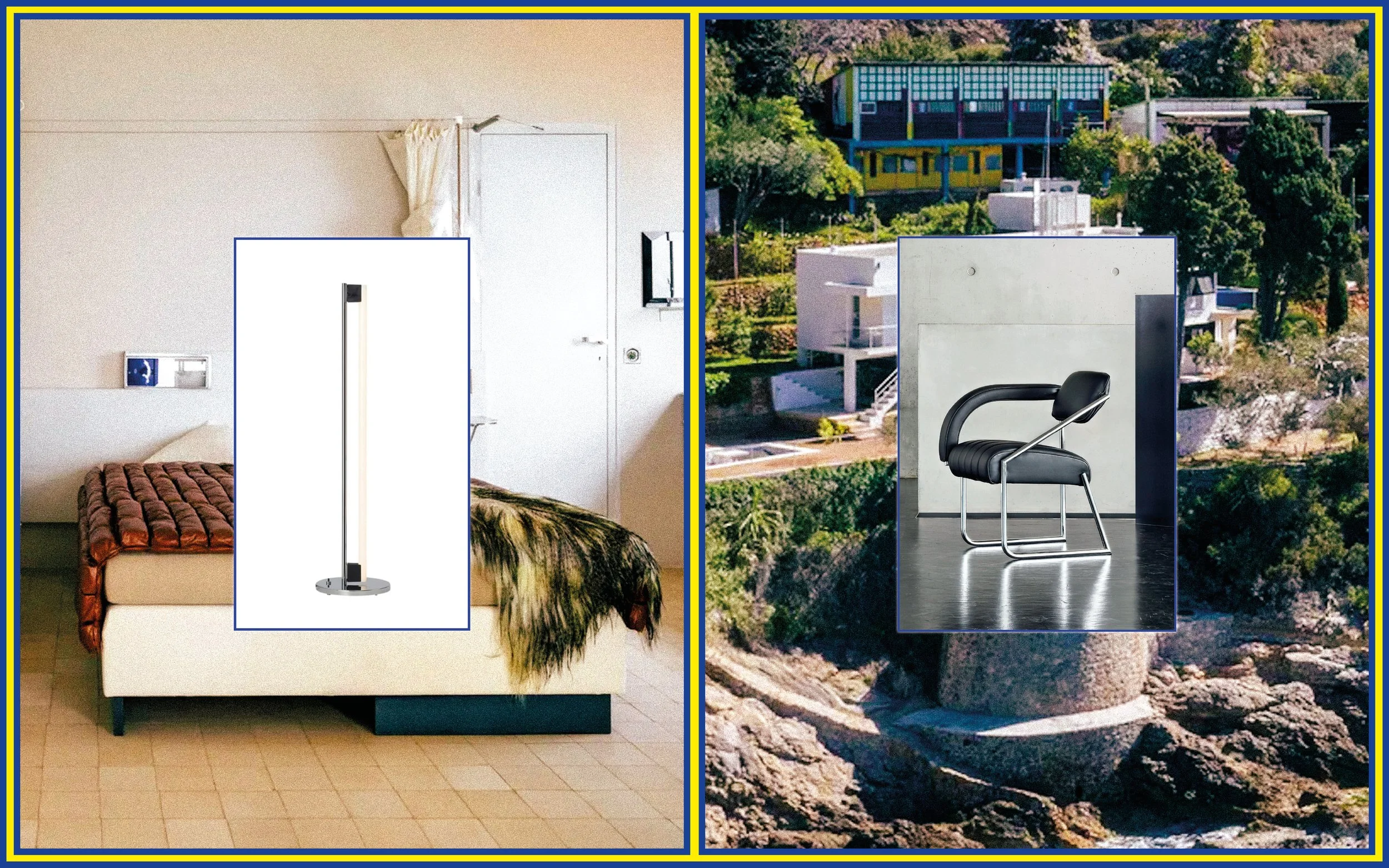
Tube Light (1927)
Gray designed the Tube Light for E-1027 the same year as the Adjustable Table, and the two objects share a sensibility: the complete subordination of form to function, pursued so rigorously that something beyond function is achieved. The lamp is a fluorescent tube held vertically by two black plastic sockets on a chrome stem rising from a circular base. There is no shade. There is no diffuser. The light source is the lamp. Gray had observed the architectural strip light becoming fashionable in the 1920s and decided, with characteristic directness, to design a floor lamp that was simply a lit tube. In period photographs of E-1027, it stands in rooms alongside the Adjustable Table and the Transat as though the three objects had always belonged together — because they had been made for the same place, by the same person, with the same conviction.
NonConformist Chair (1925–1929)
The NonConformist is primarily a precise self-description, then a chair that refuses the conventions of the armchair, without abandoning its pleasures. A tubular chrome frame supports a body of upholstery that wraps around the sitter with unusual completeness: the curved back, the generous seat, the arms at exactly the right height. It is a chair designed for sustained occupation,3 for reading, for conversation, for the long hours of a day at the sea. In the restored E-1027, it sits alongside the Bibendum and the Transat as one of three distinct propositions about how a body might be held by a chair. Each answers the question differently. Gray apparently needed all three answers present in the same room.
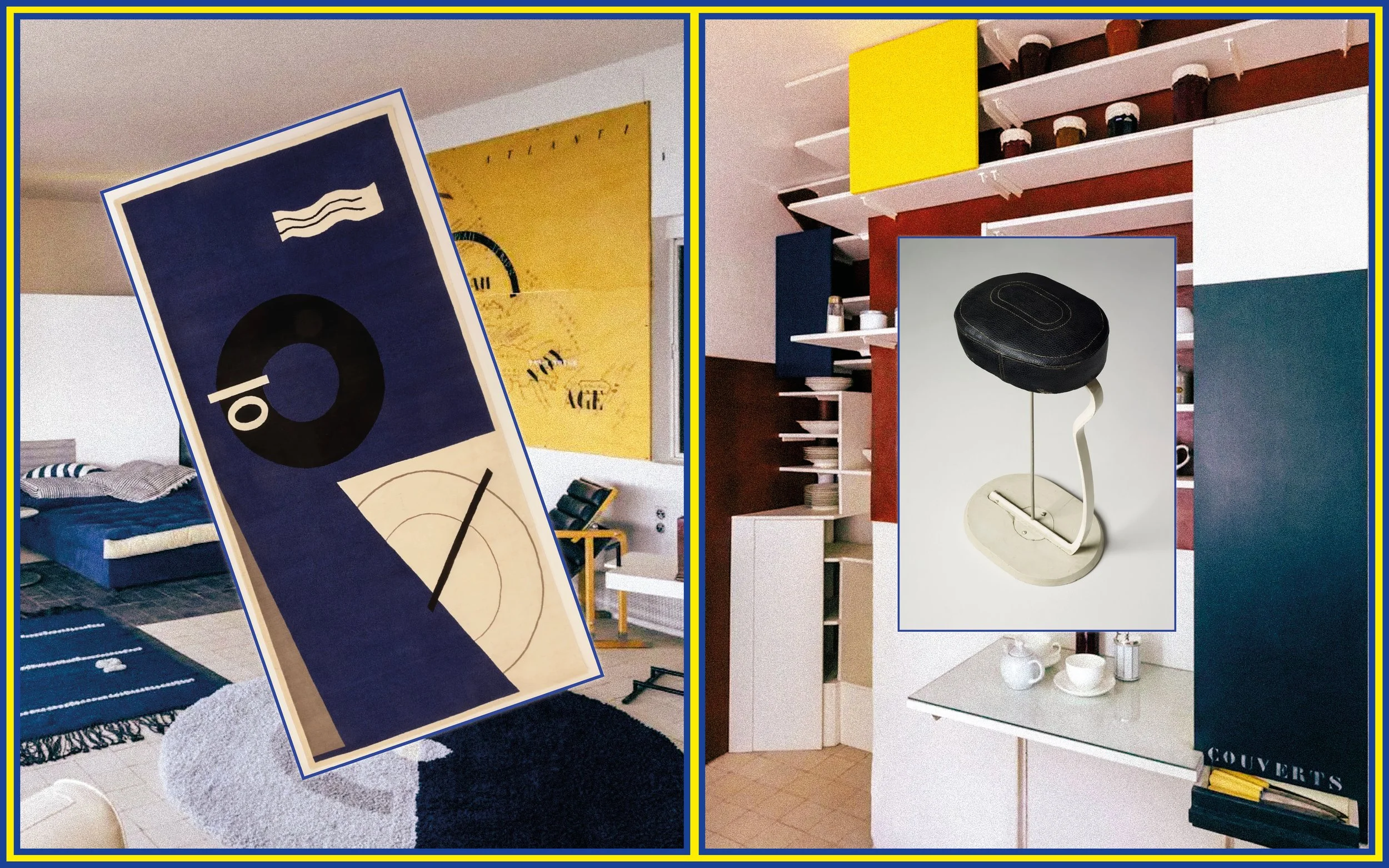
Méditerranée Rug (1929)
Gray wove rugs throughout her career, and they are among the most underestimated elements of her practice. The Méditerranée, designed for E-1027, takes its name from the sea visible through every window of the house — the deep blue of the water, the white of the light. The geometric abstraction of its pattern connects it to the De Stijl influence that ran through Gray's work in the late 1920s, but the palette is entirely Mediterranean: warm, salt-bleached, luminous. In a house where every surface was considered, the rug grounds the room without dominating it. It is the horizontal plane that completes the composition — the surface underfoot that makes the space inhabitable rather than merely beautiful.
Stool E-1027
The Stool is the quietest object in E-1027, and perhaps the most characteristic. A circular seat on a tubular steel frame, it can be placed beside a chair, used at a dressing table, moved to wherever it is needed. It makes no argument for itself. It simply resolves the question of where to sit when the chairs are occupied, or where to rest something at the right height, or where to perch for a moment before moving on. Gray designed dozens of objects for E-1027 at this scale — built-in storage, reading arms, pivoting drawers — and the Stool belongs to that category of solution: modest in ambition, perfect in execution, invisible until it is needed and then exactly right.
What E-1027 demonstrates, more completely than any manifesto, is that the modernist project was not about the machine. It was about the person inside the machine. Gray understood something that many of her contemporaries did not: that rigour and comfort are not in opposition, that a house can be geometrically precise and deeply sensuous at the same time, that the discipline of the grid and the warmth of the body can inhabit the same room. The objects she made for this house are not furniture in any ordinary sense. They are arguments — quiet, patient, unanswerable.