A-Z Design Lexicon: Eileen Gray
A-Z DESIGN LEXICON is a curated archive of the names, ideas, and works defining the design landscape.
“I have never worked to please others. I have always done what I felt, what I believed.”
Eileen Gray spent nearly a century alive and most of it working — quietly, independently, without institutional support or critical recognition, in a field dominated entirely by men who knew one another and promoted one another’s ideas. She was born in Ireland in 1878, trained in London and Paris, and died in Paris in 1976 at the age of ninety-eight. For most of that life, her name appeared nowhere in the canonical accounts of modernism. Le Corbusier’s did. Mies van der Rohe’s did. Marcel Breuer’s did. Gray’s did not, though her work anticipated theirs, equalled theirs, and in certain respects surpassed it.
She came to design through craft. As a young woman in Paris she encountered the Japanese lacquer artist Seizo Sugawara, who taught her a technique of almost inhuman patience — layer upon layer of lacquer applied, dried, sanded, applied again, over months and sometimes years. It was in this discipline that Gray first learned what she would spend the rest of her life refining: that the surface of a thing is not decoration but structure, that what an object feels like under the hand is as important as what it looks like to the eye. From lacquer she moved to furniture, from furniture to rugs, from rugs to architecture. The thread running through all of it was the same: the human body, its comfort, its needs, its sensory life.
Her rediscovery came late. In 1972, the Royal Society of Arts in London appointed her Royal Designer for Industry. She was ninety-three. The following year, the auction of an early patron’s estate brought her lacquer work to public attention for the first time in decades. By then, the Adjustable Table, the Bibendum, the Transat were already beginning their second life as production pieces. Gray lived long enough to see it, but not long enough to fully understand how completely the world had come around to her.
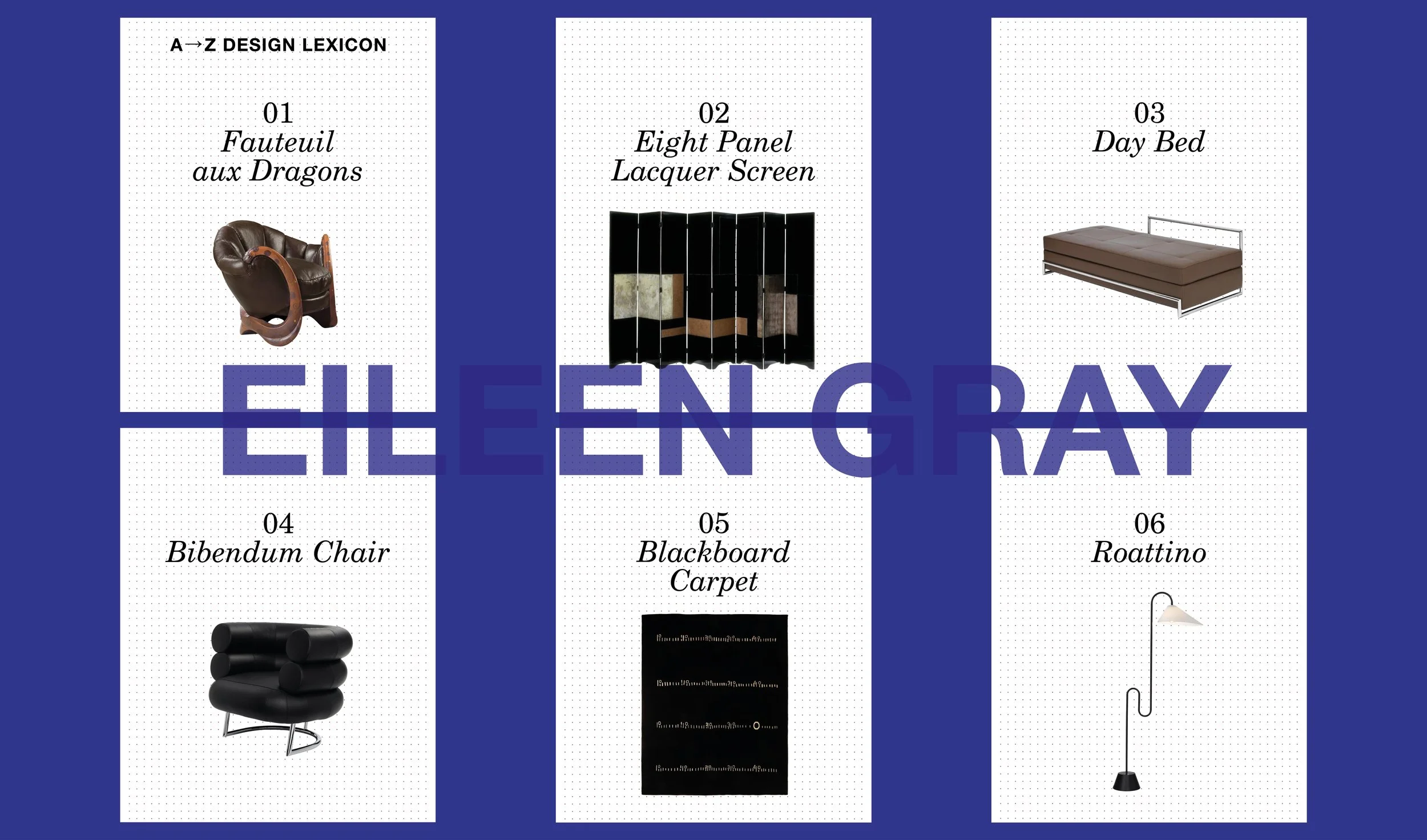
Fauteuil aux Dragons (1917–1919)
The Dragons Chair is the object with which Gray’s reputation was violently restored. When it sold at Christie’s in Paris in 2009 — from the estate of Yves Saint Laurent, who had owned it since 1973 — it fetched €21.9 million, the highest price ever paid for a piece of twentieth-century decorative art. The chair had been made for Suzanne Talbot, a Parisian milliner who was Gray’s first patron to commission a complete interior. It is small — only sixty-one centimetres tall — and extraordinary: a brown leather seat whose arms are formed by two lacquered wooden dragons, their bodies carved in sinuous relief, their eyes picked out in black lacquer on white, their scales detailed with a precision that required two years of work. The Dragons Chair belongs to the tradition of the great lacquer objects of Asia that first drew Gray to the craft, but it is entirely her own invention — a piece that is simultaneously ancient and modern, decorative and structural, intimate and monumental. It is the object that shows where she came from. Everything else shows where she went.
Eight-Panel Lacquer Screen (1918–1925)
Gray made screens throughout her early career, and they are among the most complete expressions of her lacquer practice. The eight-panel screen is a work of sustained obsession: each panel built up over months in layers of lacquer — black, brown, silver — incised and inlaid with abstract geometries and organic forms that move between East and West without settling in either. A screen is, by definition, a thing that divides space — that creates privacy, changes the acoustics of a room, redirects the eye. Gray understood this function and made it beautiful. She also understood that a screen is not a wall: it is a proposition, a temporary arrangement, a surface that can be moved and repositioned as the life of the room changes. In this sense her screens belong to the same thinking as her adjustable tables and folding chairs — objects that accommodate the human being rather than requiring the human being to accommodate them.
Day Bed (1925)
The Day Bed is the object that makes the clearest argument for Gray’s understanding of rest as a serious subject. A rectangular mattress on a chrome tubular frame, its surface tufted into a grid of rectangles, the frame rising above the seating plane to form a back rail that is also a place to lean a cushion or drape a blanket. It is neither a sofa nor a bed but something between — a surface for the hours that are neither sleeping nor sitting, for the particular quality of horizontal repose that belongs to an afternoon by the sea. Gray described it, with characteristic understatement, as offering “pleasant and comfortable seating and, moreover, particularly suited to relaxing.” What she did not say was that it is also one of the most beautiful objects she ever made: its proportions so considered, its geometry so resolved, that it becomes the centre of any room in which it is placed.
Bibendum Chair (1926)
The name comes from the Michelin Man — Bibendum, the rotund figure made of tyres who has advertised Michelin products since 1898 — and the resemblance is unmistakable: the semicircular back and armrest, stuffed and upholstered, stack like rings above a chrome tubular base. But the Bibendum is not a joke. It is one of the most thoroughly considered seating designs of the twentieth century, a chair that holds the body with a completeness that few objects achieve. The chrome base is precise and industrial; the upholstery is generous and warm. The tension between those two registers — between the hardness of the structure and the softness of what it encloses — is the same tension that runs through all of Gray’s best work. She called it balance. It is also the reason the Bibendum remains in production a century after it was made, in the same form, without revision.
Blackboard Carpet
Gray’s rugs are the least visible part of her reputation and the most unjustly neglected. She designed them throughout her career — geometric abstractions in hand-knotted wool that connect her to De Stijl, to the Bauhaus weavers, and to a tradition of textile thinking that was developing independently of the furniture world in the 1920s. The Blackboard Carpet takes its name from its field of deep black, across which geometric forms move in white and grey — a surface that is simultaneously floor covering and abstract painting. It is one of Gray’s most radical designs, the closest she came to pure abstraction, and it demonstrates something that her furniture also demonstrates but less visibly: that she thought in terms of the whole room, that every surface — vertical, horizontal, underfoot — was part of the same composition. A rug, for Gray, was not a finishing touch. It was a structural decision.
Roattino Floor Lamp
The Roattino belongs to the later phase of Gray’s practice, after the E-1027 period had established her language and she was applying it with increasing confidence to individual objects. A floor lamp of chrome tubular steel, its shade adjustable, its proportions those of an object that knows precisely how much space it needs to occupy and takes no more. Where the Tube Light of 1927 was an act of radical reduction — the lamp stripped to nothing but the light source itself — the Roattino reintroduces the idea of the shade, but treats it as a functional instrument rather than a decorative one: a surface that directs light, controls it, places it where it is needed. It is a lamp that serves. In the context of Gray’s broader practice, it demonstrates something important: that her rigour was never dogma. She returned to the question of the lamp and gave it a different answer, because the situation called for a different answer.
What holds these six works together is not a period or a style but a sensibility — one that predates the systems it appears to belong to. Gray’s lacquer work anticipates Art Deco without submitting to it. Her tubular steel furniture parallels the Bauhaus without owing it anything. Her rugs connect to De Stijl without declaring allegiance. She was, throughout her long career, a designer who worked from the inside out — from the body, the sensation, the specific experience of being in a room — rather than from theory toward object. The systems came later. The sensuality was always there first. That is what makes her work, across seven decades and radically different materials and forms, feel like the work of a single sustained intelligence: not a style, but a conviction — that the designed world exists for the person inside it, and that getting that relationship right is the whole of the task.